Economy
Kaduna LGAs Approve N152.4 Billion Budget with N91 Billion for Recurrent Spending
Here is the thing. Kaduna’s 23 local governments approved a N152.4 billion budget. Recurrent spending takes N91 billion. So here we are. What is left for the people? For the roads and the clinics? The math is simple. The story is old.


Kaduna LGAs Approve N152.4 Billion Budget with N91.44 Billion for Recurrent Spending
Published: 12 March, 2026
Where does the money go when it finally reaches Nigeria’s grassroots? The twenty-three local government councils in Kaduna State have an answer for 2026: a combined budget of N152.4 billion. But there is a catch. A full N91.44 billion of that is marked for recurrent spending—salaries, overheads, and allowances. As the Kaduna State Ministry for Local Government Affairs confirmed this month, that means sixty kobo of every naira is spoken for before a single project begins.
This brings us to the persistent arithmetic of local governance. According to a breakdown from the ministry, that N91.44 billion represents approximately 60% of the total. The remaining N60.96 billion, or 40%, is all that’s left for capital expenditure. This ratio isn’t new. But it exists in a context where these councils are legally responsible for primary healthcare and basic education. The aggregate budget itself is up from the N123.3 billion approved for the previous year, as BusinessDay reported in 2025. More money, same old split.
The Anatomy of the N91.44 Billion Recurrent Bill
Personnel costs are the giant here. Salaries, pensions, and gratuities for local government staff and primary school teachers take the lion’s share. Overhead costs—travel, utilities, vehicle maintenance—consume the rest. A senior official at the Kaduna State Ministry for Local Government Affairs told me, off the record, that in some LGAs, personnel costs alone can swallow over 70% of the recurrent budget. This leaves a thin margin for anything else.
The trouble is, this mirrors a national headache. The World Bank noted in a 2025 report that Nigerian subnational governments routinely allocate a high share of resources to recurrent items, starving public investment. In Kaduna, the pressure is intensified by a revised minimum wage and past staff recruitments. Each council has this cost structure, but their revenues—from FAAC and meager internal sources—vary wildly. The disparity in fiscal health is profound.
The Capital Expenditure Dilemma
Now, consider the N60.96 billion for capital projects. It must stretch across twenty-three LGAs. It must cover clinic renovations, classroom construction, water schemes, and feeder roads. Spread that thin, the impact per council is inevitably limited. A chairperson from the southern part of the state lamented that after mandatory projects, the capital portion rarely addresses the backlog of community needs.
But wait, it gets more complex. Historical data shows capital releases often lag behind recurrent ones. The 2024 fourth-quarter budget implementation report from the Kaduna State Bureau of Statistics confirmed local governments performed better on recurrent spending than on capital. The execution bias tilts spending further toward salaries and overhead, making the actual split worse than the 60-40 plan suggests.

Revenue Foundations and Fiscal Autonomy
The entire N152.4 billion plan hinges on monthly FAAC windfalls. Kaduna State received N13.6 billion for its local governments in February 2026, up from N11.6 billion in January. Internally Generated Revenue is still a footnote. As Punch noted in 2025, IGR contributes less than 10% to total revenue in most jurisdictions. Budget planning here is an exercise in hoping federal allocations arrive.
This brings us to the delicate dance of autonomy. The Kaduna State government, through its ministry, oversees LGA budget preparation. The goal is fiscal discipline. The effect, as some analysts argued in Vanguard last year, can be centralized control that delays funds and imposes state priorities. The real autonomy of an LGA chairman to address needs within this budget is questionable.
“The budget is a statement of intent, but the real story is in the cash backing. When revenues fall short, it is the capital projects that are first deferred to keep the payroll running.” – Dr. Mahmud Shuaibu, Public Finance Analyst, in an interview with The Guardian (March 10, 2026).
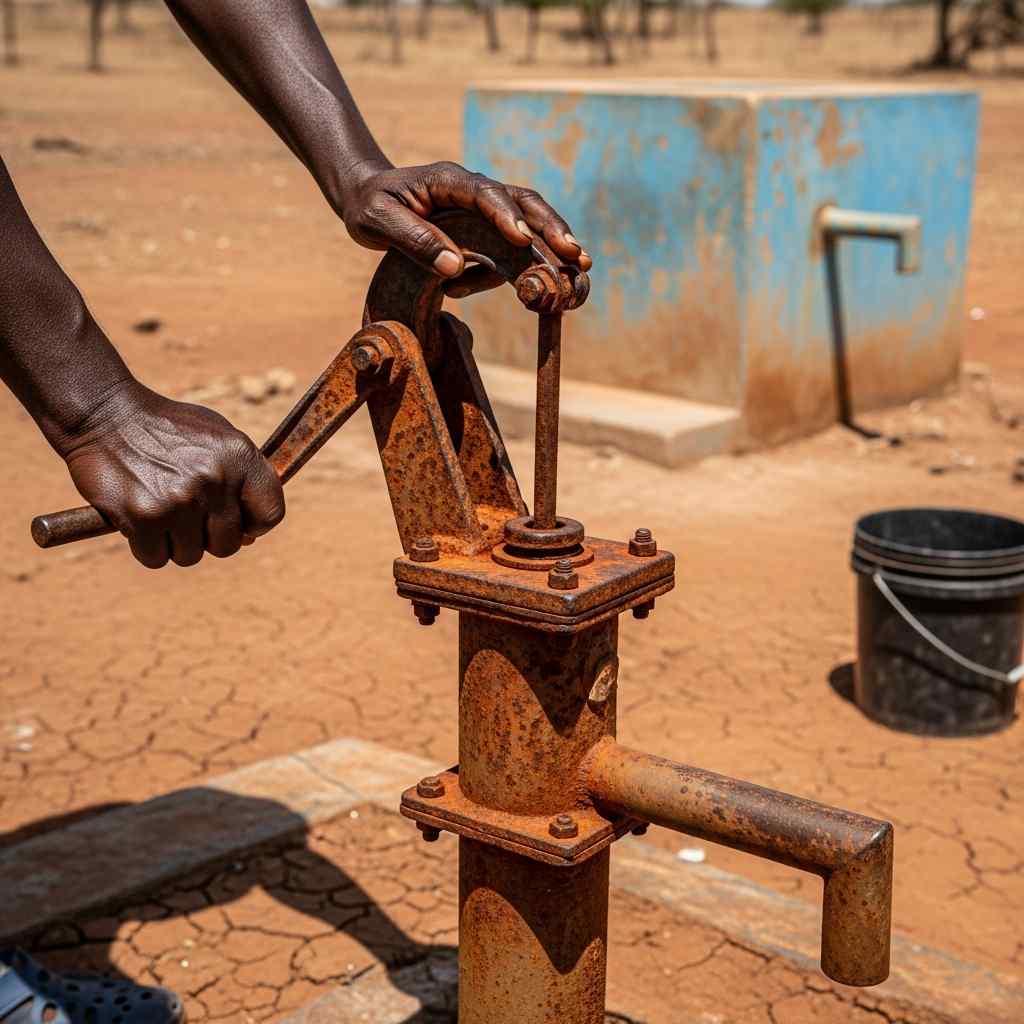
The weight of administration measured against the lightness of water.
Comparative Context and the Service Delivery Squeeze
Kaduna’s 60% recurrent ratio is not an outlier. A 2025 review by Nairametrics across six states found averages between 55% and 65%. The consequence is a brutal squeeze on the sectors LGAs are meant to run. A rural health center may have its staff paid, but the money to fix its roof fights for space in that shrunken capital pot.
Contrast this with demographic pressure. Kaduna has a large, predominantly rural population. Do the math: that N60.96 billion capital allocation breaks down to roughly N6,000 per resident. That figure illustrates the funding gap. The high recurrent commitment, while keeping government doors open, directly shrinks this per capita investment in people’s lives.
A Mandatory Capital Project Transparency Portal
So what can be done? One intervention is straightforward. Each of the twenty-three councils should be mandated to run a simple, public online portal. It would detail every capital project from the N60.96 billion pot: project name, location, contractor, cost, and status with photos.
The model works at the state level. Replicating it at the LGA would cost little—a tiny fraction of the N91.44 billion recurrent overhead. But the discipline it imposes would be powerful. Communities could track projects meant for them. Data would be generated.
By the end of 2026, the State House of Assembly and civil society would have a clear record of what the 40% capital share actually built. The debate for 2027 could then move beyond aggregate percentages to tangible outcomes. The technology is basic. The requirement is simple. For a system choked by recurrent costs, it’s a way to force accountability on the part of the budget that’s supposed to build.









Economy
Multinational Exodus in Nigeria Deepens with N94 Trillion Loss
Here is the thing. Multinational exits cost Nigeria N94 trillion. Official rates may stabilize. But the manufacturing crisis stays. So here we are.

The Multinational Exodus in Nigeria Deepens with a N94 Trillion Hole
Published: March 24, 2026
How do you measure an economy bleeding out? Start with N94 trillion. Add over 20,000 direct jobs. That is the quantified damage from major international companies leaving Nigeria since 2021. A report from the Manufacturers Association of Nigeria confirms this accelerating trend through the first quarter of this year, as Premium Times noted in March 2026. The domestic market cannot replace this lost output. Not even close.
Here is the thing about the numbers
The N94 trillion figure is an aggregation. It covers divestments, asset sales, and profits that could not be repatriated over five years. The trouble is, new money is not coming in to replace it. Data from the National Bureau of Statistics shows foreign direct investment inflows have declined for four consecutive years (NBS, 2025). The job losses, concentrated in manufacturing, ripple outwards. They hit supply chains and service providers hard.
Look at the names. Procter & Gamble, GSK, and Sanofi have exited manufacturing. Unilever stopped making home care and skin cleansing products. Bolt Food and Jumia Food shut down in late 2023. Each closure cited a similar cluster of problems.
What exactly are companies running from?
Ask any business operator in Lagos or Port Harcourt. The list is short and brutal. A survey by the Lagos Chamber of Commerce and Industry pins the primary constraints as foreign exchange volatility, persistent insecurity, and unreliable power (LCCI, 2025). The cost of generating electricity with diesel alone consumes massive chunks of operational budgets.
But there is a catch. Even though the Central Bank of Nigeria has unified the exchange rate window, access to foreign currency remains a daily struggle. As BusinessDay reported in early 2026, implementation gaps frustrate corporate treasury departments. You cannot plan when you cannot source dollars for raw materials.
You cannot run a factory where you cannot source inputs, guarantee staff safety, or predict your energy cost from one week to the next. The Director-General of the Manufacturers Association of Nigeria, Segun Ajayi-Kadir, stated in January 2026.
Insecurity along major transit routes inflates logistics costs and insurance premiums. Moving goods from Lagos to Abuja can cost as much as shipping a container from China to Lagos. These are the mundane realities that kill profitability.
The policy response feels like a broken record
The government of President Bola Tinubu has announced interventions. The 2024 and 2025 budgets allocated funds for national security and infrastructure. The rhetoric is all about improving the ease of doing business.
Here is the reality check. The total capital expenditure in the 2025 budget was approximately N11.99 trillion (Budget Office of the Federation, 2025). The amount lost to corporate exits in five years is nearly eight times that single year’s capital budget. The scale of the outflow dwarfs planned public investment.
Tax incentives exist on paper. The experience on the ground involves navigating delays at the Federal Inland Revenue Service and the Nigeria Customs Service. A company choosing between Nigeria and Ghana will weigh these operational headaches heavily.
Who fills the space left behind?
The exit creates opportunities. Local conglomerates like the Dangote Group, BUA Group, and Flour Mills of Nigeria have expanded into vacated segments. This shift promises greater domestic ownership.
But capacity has limits. The Aliko Dangote-owned refinery represents exceptional scale. Most local manufacturers lack the balance sheet to absorb the massive capital expenditure and technology the departing multinationals possessed. The quality and variety of goods may decline.
Job creation from local firms is slower and more cautious. They face the same headwinds, often with less access to global financing. The net result is a shrinkage in formal sector employment.
Local production is growing, but it is a marathon, not a sprint. We cannot replace 50 years of multinational investment in two years. The CEO of a major Nigerian food and beverage company commented anonymously to Vanguard in February 2026.

The view from the street in Ikeja or Apapa
For workers, it means fewer stable, pensionable jobs. The 20,000 lost positions were mostly formal roles with benefits. Many move into the informal sector or precarious gig work. The unemployment rate is officially 4.1% (NBS, Q3 2023), though a methodology change affects comparability. Underemployment is the larger issue on the ground.
Consumers face higher prices and reduced choice. Imported alternatives get more expensive with currency depreciation. Locally produced substitutes may have inconsistent quality. The standard of living adjusts downward.
Landlords in industrial areas see vacancies rise. Local vendors lose their largest clients. The economic ecosystem around a major plant deteriorates fast. The impact is hyper-local and deeply felt.
Is there a path to reverse the trend?
Stopping the exodus requires treating root causes. Foreign exchange management needs consistency and transparency. Investors require a predictable window to repatriate dividends. The Central Bank of Nigeria has made commitments, yet market confidence lags, as The Cable reported in 2026. The official rate has stabilized around N1,384 per dollar, but access liquidity stays constrained.
Security of life and property is non-negotiable. Investment in policing must show results. The power sector remains a national emergency. The cost of alternative power makes manufacturing a heroic undertaking.
This brings us to coordination. Policy across the Ministry of Industry, Trade and Investment, the Central Bank, and the Ministry of Finance lacks urgency. Businesses receive mixed signals.
A single, tangible step forward
The government could establish a dedicated Presidential Delivery Unit for the top five investor complaints. This unit would track and publicly report monthly progress on foreign exchange access, port clearance times, diesel prices, and security on trade corridors. Transparency builds accountability.
It would have the authority to cut through inter-agency delays. Its mandate would focus exclusively on removing bottlenecks for existing businesses. Success would be measured by a halt in closure announcements. The current approach of generic assurances has lost credibility.
Such a unit needs a leader with direct presidential access and a small, technically competent team. Its reports should be published online in a simple dashboard. Nigerians and the international business community can then monitor progress with specific metrics. This move signals a shift from talking to doing.
So here we are
The multinational exodus in Nigeria is a story of capital, jobs, and confidence leaving. The total of N94 trillion and 20,000 jobs makes it quantifiable. The reasons are well-documented.
Reversal is possible with focused, sustained action on power, security, and foreign exchange. The alternative is a continued contraction of the formal industrial base, higher unemployment, and import dependence. The choice for policymakers in Abuja is that straightforward.
The next closure announcement may come tomorrow. The time for a different response is today.
Economy
Nigeria Food Prices and the Tax Burden on the Supply Chain
Here is the thing. Food prices keep rising. Why? Look at the supply chain. Farmers pay. Transporters pay. Market sellers pay. So here we are. Your wallet feels it. The tax burden moves down the line until it stops with you.

The Price on Your Plate
Published: 24 March, 2026
What is the true cost of a bag of rice. It is no longer just the price of seeds, labour, and milling. The figure you see today is a ledger of levies, a receipt for every checkpoint between the farm and your kitchen. The National Bureau of Statistics reported that the food inflation rate hit 37.92% in February 2026. That number confirms the pain. But it does not explain the chaos behind it.
From Farm to Market, a Trail of Tickets
Food does not just travel in Nigeria. It pays. A truck moving tomatoes faces a gauntlet. Each state government, and the local councils within them, demands a fee. The Manufacturers Association of Nigeria documented over 50 different taxes and levies affecting businesses in 2025. Many target goods in transit.
But wait, it gets more complex. A report by Premium Times in late 2025 tracked a single truck of onions. The driver paid 14 separate informal levies on the trip from Kano to Port Harcourt. Receipts. Rarely issued. Farmers pay. Transporters pay. Aggregators pay. Each layer adds a government charge long before the produce ever sees a market stall.
Who Collects What, and Where Does It Go
The trouble is the thicket of authority. The Federal Government collects Value Added Tax. State governments impose Personal Income Tax and their own Road Tax. Local governments then add market fees and sanitation charges. The theory is a division. The practice is a chaotic overlap where the same activity gets charged by three different tiers. The Joint Tax Board admits this confusion crushes small businesses.
This brings us to revenue. Many states struggle fiscally. Internally Generated Revenue is a priority. The easiest targets are moving goods. So checkpoints multiply. The money collected, however, vanishes into a system with little transparency. Citizens see the high Nigeria food prices. They rarely see better roads or cleaner markets.
“The multiplicity of taxes is killing agriculture. A farmer is taxed on his seedlings, his harvest, and the vehicle that carries it. By the time the food gets to the city, the price is beyond the reach of the common man.”
Kabiru Ibrahim, National President, All Farmers Association of Nigeria, speaking at a policy dialogue in Abuja, January 2026.
The Mathematics of a Bag of Rice
Take a 50kg bag. Start at the miller. He pays an electricity levy, a business premises fee, corporate tax. He factors it in. The transporter pays for a road worthiness certificate, a state levy, a loading fee. He also budgets for unofficial settlements.
By the time that bag lands in a Lagos warehouse, its base cost has swollen by an estimated 25-30%. This is according to by Financial Derivatives Company in 2026. The warehouse owner pays property rates. The retailer pays market fees. Each actor passes the cost forward. The final consumer bears the full accumulated burden. The farm gate price is a distant memory.
The Policy Tangle and the Search for Harmony
The Federal Ministry of Finance talks about tax harmonization. The goal is to streamline. Progress is slow. The National Tax Policy imagines one agency collecting and sharing revenue. State governments guard their fiscal autonomy fiercely. They see centralization as a threat.
But there is a catch. In 2025, a committee chaired by the Vice President office recommended scrapping 15 specific nuisance taxes. Implementation across 36 states and 774 local governments is inconsistent. A federal law means little without state cooperation. The gap between policy and practice is wide enough for a truck full of taxes to drive through.
When More Taxes Mean Less Revenue
Here is the paradox. Excessive taxation can kill the trade it feeds on. High costs discourage movement. Transporters take longer, worse routes to avoid checkpoints. Spoilage increases. Some farmers quit the market entirely, growing only for themselves. The tax base shrinks.
Governments then raise rates on those left. A vicious cycle. As The World Bank noted in 2025, this complexity is a major constraint on business. For food logistics, that constraint has a direct price tag. The government might collect more per bag, but the total number of bags moving formally drops. Everyone loses.
“We are not against paying taxes. We are against harassment and duplication. Let there be one fee for using the road, paid electronically. Let that money show in the budget for road repair. What we have now is chaos that benefits only the touts at the checkpoints.”
Yusuf Lawal, Secretary-General, Nigerian Association of Road Transport Owners, interview with The Guardian, February 2026.
The Human Face of the Food Price Crisis
Walk into any market. The conversation is the same. A pepper seller in Daleko Market, Lagos, lists her daily charges, market ticket, sanitation fee, association dues, a levy for the area boys. She adds it to the price of each basket.
The office worker on a fixed salary feels every naira. Food takes over 50% of the average household spending. When Nigeria food prices rise, it is a direct cut to living standards. It fuels tension. It kills spending on anything else. The political consequences are visible. The economic damage is deep.
Is There a Path Through This Thicket
Some states are trying. Kaduna State implemented a unified electronic billing system for goods transporters. One receipt, recognised across the state. Early data from the Kaduna State Internal Revenue Service in 2025 showed reduced transit times and slightly moderated price increases. It requires political will.
The federal government could use its power over interstate commerce. Mandate a single, electronic federal levy for road transport of goods. Share the revenue with states based on the mileage. This would need a constitutional amendment. It needs immense political negotiation. The alternative is the relentless climb.
A Single Receipt on a Single Screen
The technology exists. A national logistics platform is possible. A transporter logs a and pays one fee online. The Federal Ministry of Transport and the Federal Inland Revenue Service have discussed it. The challenge is 36 state revenue agencies. Without their buy-in, it fails.
The benefit for states is predictable, automated revenue with less leakage. For the farmer and the consumer, it is a more predictable cost. Unofficial levies become obsolete. Food prices would still reflect fertilizer costs and climate. But the artificial inflation from a predatory, fragmented tax system would fall.
What You Can Do Tomorrow
Ask for a receipt. This simple act holds power. When you pay any fee, demand a proper, stamped receipt. It makes it official. It creates a record. It reduces the chance the money ends in a private pocket. If enough people demand accountability, the system feels pressure.
Engage your local councilor. The most oppressive levies often start at the local government level. Attend town hall meetings. Question every market fee. Demand to see the budget for how that revenue improves the market. Citizen pressure can force transparency. It can rebuild the connection between tax paid and service delivered. That connection is the foundation.
So here we are. The price of food is a thermometer. The reading is high. Multiple taxation on the food supply chain is a self-inflicted wound. It raises short-term cash but strangles long-term wealth. Fixing it requires moving from a culture of endless extraction to one of facilitation. The goal is , a system where the price on your plate reflects the true cost of production, not the accumulated cost of bureaucracy.
Nigeria Food Prices: Buhari’s New Price Monitoring Task Force , Channels Television. (Digital Illustration: GoBeyondLocal)
Economy
Lagos Tries Again to Fix Its Broken Building Permit Machine
Here is the thing. Lagos tries again to fix its building permit machine. Another digital system. Another promise of speed. So here we are. Will this time be different?

Lagos Tries Again to Fix Its Broken Building Permit Machine
Published: 23 March, 2026
Mr. Tunde Oke submitted his application for a block of six flats in late February. He received an acknowledgment with a tracking number the same day. Within seven working days, he received the permit approval. For a developer in Lagos, that is not normal. It is revolutionary.
The Lagos State Government launched a new electronic platform for building permit approvals in February 2026. The system promises to collapse a process that routinely takes months into 10 working days for clean applications. But there is a catch. Lagos has attempted digital reforms before. The results have been mixed.
A Process Known for Its Delays
For years, developers described the permit process as a marathon. A painful one. Applications required physical visits to multiple offices. Paper files moved between departments for stamps and signatures.
The agency responsible, the Lagos State Physical Planning Permit Authority (LASPPPA), operated an old manual system. It created room for long delays. It created room for informal negotiations.
A 2025 report by BusinessDay cited industry sources who claimed the average wait time could stretch to six months. The report contrasted this with the agency’s official service charter, which promised 28 days. The gap between promise and reality defined the experience.
The new e-system aims to erase that gap. It is called the Electronic Physical Planning Process System (EPPPS). Governor Babajide Sanwo-Olu launched it at a ceremony in Alausa. He framed it as critical for his second-term agenda.
This is a fundamental shift. We are moving the entire value chain of planning permits online. Applicants will receive updates at every stage, and our officers will be accountable to the clock on the dashboard. , Governor Babajide Sanwo-Olu, February 10, 2026 (Official State House Press Release)
How the New Digital System Is Meant to Work
The technical blueprint involves a single online portal. Applicants upload drawings and land documents. The system assigns a tracking number.
A built-in workflow routes the application to relevant officers in sequence. This brings us to the integration. The system integrates with the state’s geographic information system (GIS). This allows for automated checks against the master plan. The Commissioner for Physical Planning and Urban Development, Dr. Oluyinka Olumide, explained the logic. He said digital checks flag violations early. This prevents an applicant spending money only to be rejected later.
The system also generates the permit as a digitally signed document with a QR code. This tackles the problem of forged permits. LASBCA (Lagos State Building Control Agency) officers can now scan the code in the field for instant verification.
The QR code is key. Any law enforcement officer or community member can scan it and confirm the authenticity of the permit instantly. This brings transparency. , Dr. Oluyinka Olumide, Commissioner, February 2026 (Ministry Technical Briefing)
The Infrastructure That Makes This Possible
A digital permit system needs more than software. It needs reliable internet, digital identity verification, and electronic payment channels. Lagos has invested in some of this backbone.
For payments, the platform uses the Lagos State PayEasy system. The National Identity Number (NIN) is mandatory for individuals. For corporate entities, the Corporate Affairs Commission (CAC) registration number is required. These linkages aim to curb fraud.
The real test is in the government offices. Do officers have the devices and training? A pilot program ran in late 2025 across three district offices. The state has now expanded to 57 district offices. A January 2026 report by Premium Times noted initial resistance from some staff. The report also highlighted power supply issues at some offices.
Why Previous Attempts Stumbled
This is not the first move of Lagos. A similar initiative was announced around 2018. It faced implementation challenges. The old system lacked full integration. Applicants often started online but finished physically. This hybrid model defeated the purpose.
Corruption presented another hurdle. The manual process had opaque steps where unofficial fees could be introduced. A digital system with a fixed fee schedule and a visible audit trail threatens those informal streams. Past attempts faced passive sabotage from within.
The political will appears stronger now. The launch event in 2026 had a different tone. Top officials spoke about strict compliance. The governor mentioned direct reporting on performance metrics. This top-level attention may provide the push needed.
What follows from this
For the average person, the promise is simple: speed and certainty. Take Mr. Tunde Oke, the civil engineer in Ibeju-Lekki. He submitted an application in late February 2026. He got his tracking number the same day. Within seven working days, the system notified him of a required adjustment to his drainage plan. He made the change. He received provisional approval two weeks later. The entire process took about a month.
I have done this for fifteen years. I have never seen a response that fast from the planning office. If they can keep this up, it will change everything. The cost of delay is huge, bank interest, idle workers, security on site. , Mr. Tunde Oke, Civil Engineer and Developer, March 2026 (Interview with the author)
The cost of delay is a real economic burden. When a project is stalled, capital is tied down. Loan interest accrues. Construction materials can be stolen. A faster permit process directly reduces the financial risk.
The Larger Picture for Urban Planning
Beyond convenience, a digital permit system offers a powerful tool for urban management. Every approved application adds data to a central repository. Over time, the government will have a real-time map of all construction across Lagos.
This is invaluable for infrastructure planning and disaster management. The Lagos State Urban and Regional Planning Bill of 2025 provides the legal framework for this data-driven . With accurate digital records, the government can identify illegal structures more systematically. It can plan roads and water lines to match actual development.
As a 2025 policy paper from the Lagos State Research and Development Council noted, efficient land administration could increase the state’s Internally Generated Revenue. Property taxes are easier to collect when there is a reliable digital record of all buildings.
The road ahead
No reform is without challenges. The first hurdle is digital literacy. Not all applicants, particularly older homeowners, are comfortable online. The government has set up help desks at physical offices.
The second hurdle is system integrity. Can the platform handle the volume from a megacity? What happens during server downtime? The Ministry says there is a business continuity plan for a fallback process. This fallback could become a permanent loophole.
The third and most sensitive hurdle is internal resistance. Some officers may find ways to create new digital bottlenecks. They might delay the routing of files or insist on endless physical verification visits. Sustained political oversight is crucial.
So what is really happening?
Lagos often serves as a laboratory for Nigeria. Other states watch closely. The success or failure of this e-permit system will influence initiatives in Abuja, Port Harcourt, and Kano.
The federal government’s ease of doing business council has highlighted construction permits as a major constraint. A successful Lagos model could provide a template for a national standard.
As The Guardian noted in March 2026, the Director-General of the Lagos State Public Procurement Agency, Mr. Fatai Onafowote, linked the reform to larger economic goals. He argued predictable regulation attracts investment. A transparent digital system makes Lagos a more calculable market.
What You Can Do Right Now
The system is live. The portal is accessible through the Lagos State government digital platform. Gather all necessary documents in digital format first. Use the official fee calculator. Make payments only through the integrated channels.
Keep your tracking number. Check the status regularly. If the system stalls beyond the promised 10 working days, use the official escalation channel. Public demand for the system to work is part of what will keep it accountable.
The launch is a significant event. It can reshape how the city grows. The reality will be determined in the coming months, as thousands of applications flow through the digital pipeline. Lagos is trying to fix a broken machine. The whole country is watching.
Lagos Govt Launches Building Planning Permit Sensitisation Tools , Official launch and sensitisation for the new EPPPS digital permit system. (Digital Illustration: GoBeyondLocal)

Thunder Speaks Sentences on the Jos Plateau

River Disappears Overnight in Warri Delta State

Market Woman Predicts Deaths in Owerri Through Yam Shapes

Forest healer cures blindness using leaves from a plant found nowhere else

Ancient Wall Repairs Itself in Zaria After Heavy Rains

Confluence refuses to mix after a photographer insulted the local river spirit

Church roof collapses mid sermon and every person inside walked out without injury

Tailor Sews Identical Dress from 40-Year-Old Bible Photo in Asaba

Twins Share Single Heartbeat Born Years Apart

Tomi Adeyemi Film Deal Changes Nigerian Storytelling

Lola Shoneyin Builds a Literary Continent at Aké Festival

ADC Leads #OccupyINEC Protest in Abuja Over Party Derecognition

Internet Sovereignty: Why Some Countries Want Their Own Separate Internet

The Story Of The Nigerian Who Helped Build Global Internet Systems

Nigerian Hackers: The Global Fraud Story and Its Fallout

Forgotten Satellites Defy Silence, Beaming Signals for Decades

Your Digital Store in Nigeria and the Reality of Domain Expiration

The Phone Stay So Quiet: An Investigation into Nigeria’s Silent Customer Lines

The Business That Died: A Nigerian Case Study in Refusal to Adapt

Hiding Your Business From People With Money

How Nollywood Grew Without Government Support

Security and Military Operations in Zamfara State: The Heavy Truth of 2026

Nigeria Produces 67 Percent Global Yam Output

Comedy Industry in Nigeria and Its Economic Contribution

 Digital Sovereignty2 months ago
Internet Sovereignty: Why Some Countries Want Their Own Separate Internet
- Diaspora2 months ago
The Story Of The Nigerian Who Helped Build Global Internet Systems
- Crime2 months ago
Nigerian Hackers: The Global Fraud Story and Its Fallout
- Space Technology2 months ago
Forgotten Satellites Defy Silence, Beaming Signals for Decades
- E-Commerce2 months ago
Your Digital Store in Nigeria and the Reality of Domain Expiration
- Edutech Portal2 months ago
The Phone Stay So Quiet: An Investigation into Nigeria’s Silent Customer Lines
- Edutech Portal2 months ago
The Business That Died: A Nigerian Case Study in Refusal to Adapt
- Business2 months ago
Hiding Your Business From People With Money