Construction & Housing
Cheapest Building Materials in Nigeria for 2026 House Projects
You want to build a house in 2026. Money is tight. So here we are. What are the cheapest building materials in Nigeria right now? Blocks. Bamboo. Local options. This is the list you need. Save money. Build your home.

A bag of cement sold for an average of N7,500 in the first quarter of 2026. This price is the starting point for any conversation about building a house in the country. The search for cheapest building materials in Nigeria is a daily calculation for millions.
The foundation of cost is local material
Published 31 March, 2026
Here is the thing. The most affordable materials are those you find close to the site. Transport adds a major layer of expense. A lorry load of sharp sand that costs N80,000 in Ogun State can double by the time it reaches a site in Lagos due to logistics and levies.
The National Bureau of Statistics tracks this in its construction materials report. The average price for a tonne of sharp sand across 36 states was N31,500 in December 2025. River sand averaged N35,000 per tonne. These are the literal building blocks of any budget. You see the logic. A builder in Rivers State uses more river sand. A builder in Kano uses more laterite. The material under your feet often presents the first savings.
Sandcrete blocks still rule the market
Walk through any building site from Port Harcourt to Sokoto. You will see stacks of sandcrete blocks. They are the dominant walling material because the production process is straightforward. The recipe is just cement, sand, and water.
The price for a standard 9-inch block fluctuates wildly. In Abuja, prices ranged from N450 to N550 per block in early 2026. In Lagos, the range was N480 to N600. The variation depends on the cement content and the location of the block industry. A report by BusinessDay in February 2026 quoted block makers in Ota. They linked price changes directly to weekly cement costs. The lesson is straightforward. Monitor cement prices to predict block costs.
Bamboo has entered the conversation
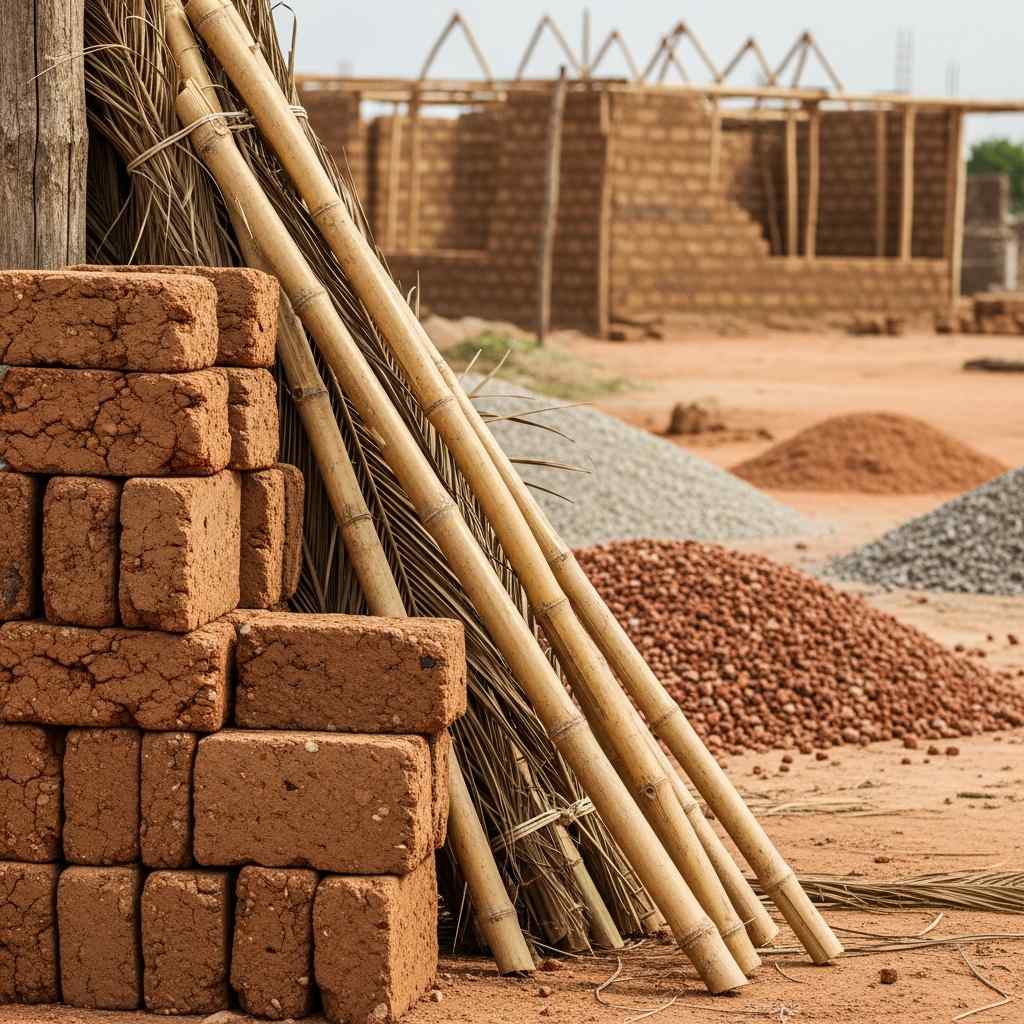
Let me break it down. Bamboo is a grass that grows rapidly in southern and central Nigeria. It is a renewable resource. Research institutes like the Forestry Research Institute of Nigeria have promoted its use for scaffolding, roofing, and even structural frames.
The cost advantage is significant. A long bamboo pole suitable for scaffolding can cost between N500 and N1,500. Compare that to a steel scaffold tube. The initial outlay is lower. The material is lighter, which reduces labour costs during handling. Professor Abdullahi Onilude, a researcher with FRIN, discussed this in a 2025 seminar. He stated treated bamboo has a lifespan exceeding 25 years for construction purposes. The treatment process to prevent insect attack adds to the cost but continues to be economical.
“The perception that bamboo is a poor man’s material is outdated. With current treatment and engineering, it is a viable, low-cost structural option for residential buildings.”
– Professor Abdullahi Onilude, Forestry Research Institute of Nigeria, 2025.
Laterite and stabilized earth make a comeback
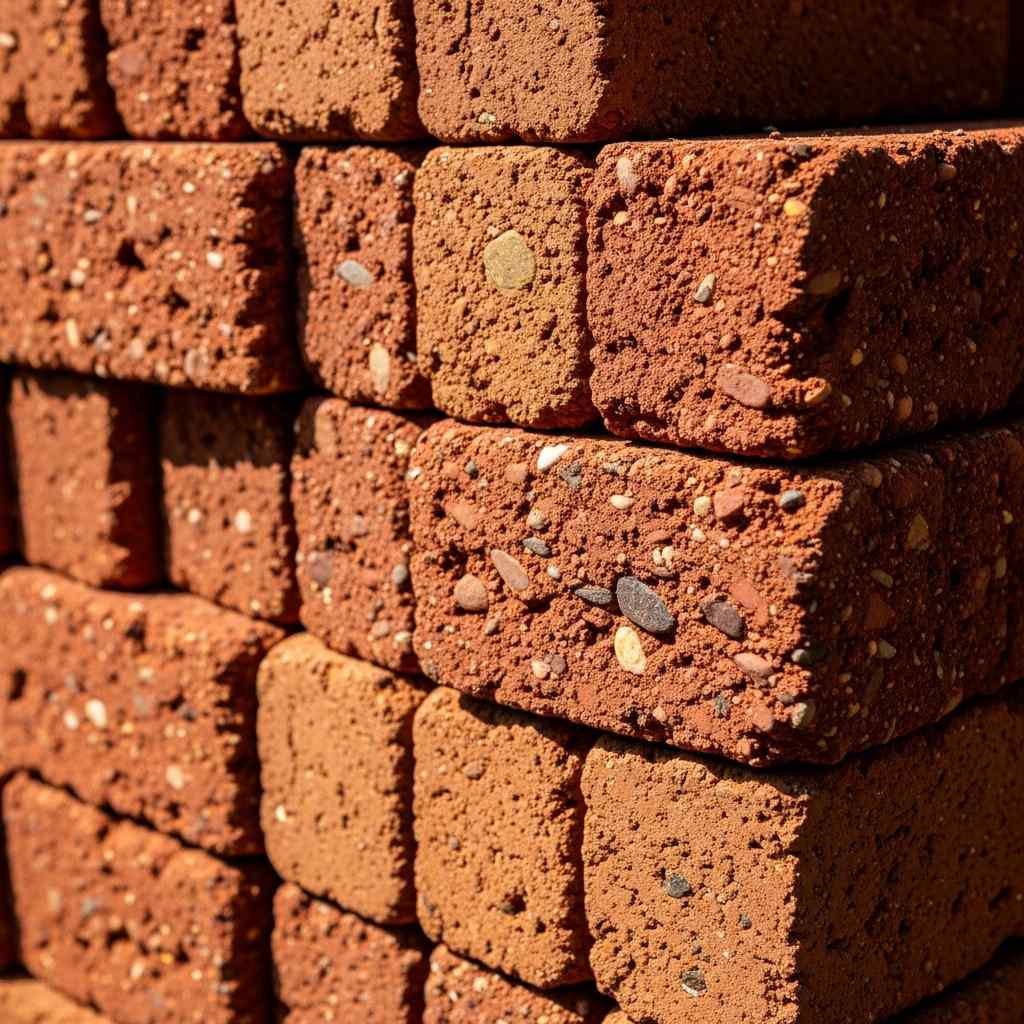
So here we are. Before cement blocks, people built with earth. The method is experiencing a revival under terms like ‘rammed earth’ or ‘compressed stabilized earth blocks’. CSEBs use local soil mixed with a small amount of cement or lime.
The primary cost is the soil, which is often free on-site. The stabilizer, like cement, constitutes about 5-10% of the mix. A hydraulic press machine forms the blocks. The machine represents the main capital cost, but community cooperatives or enterprising individuals often own one. A study published in the Nigerian Journal of Technology in 2025 analyzed costs. It found CSEB walls could be 30% cheaper than sandcrete block walls for a single-story building. The thermal insulation properties are better, reducing future spending on cooling.
Corrugated iron sheets for roofing
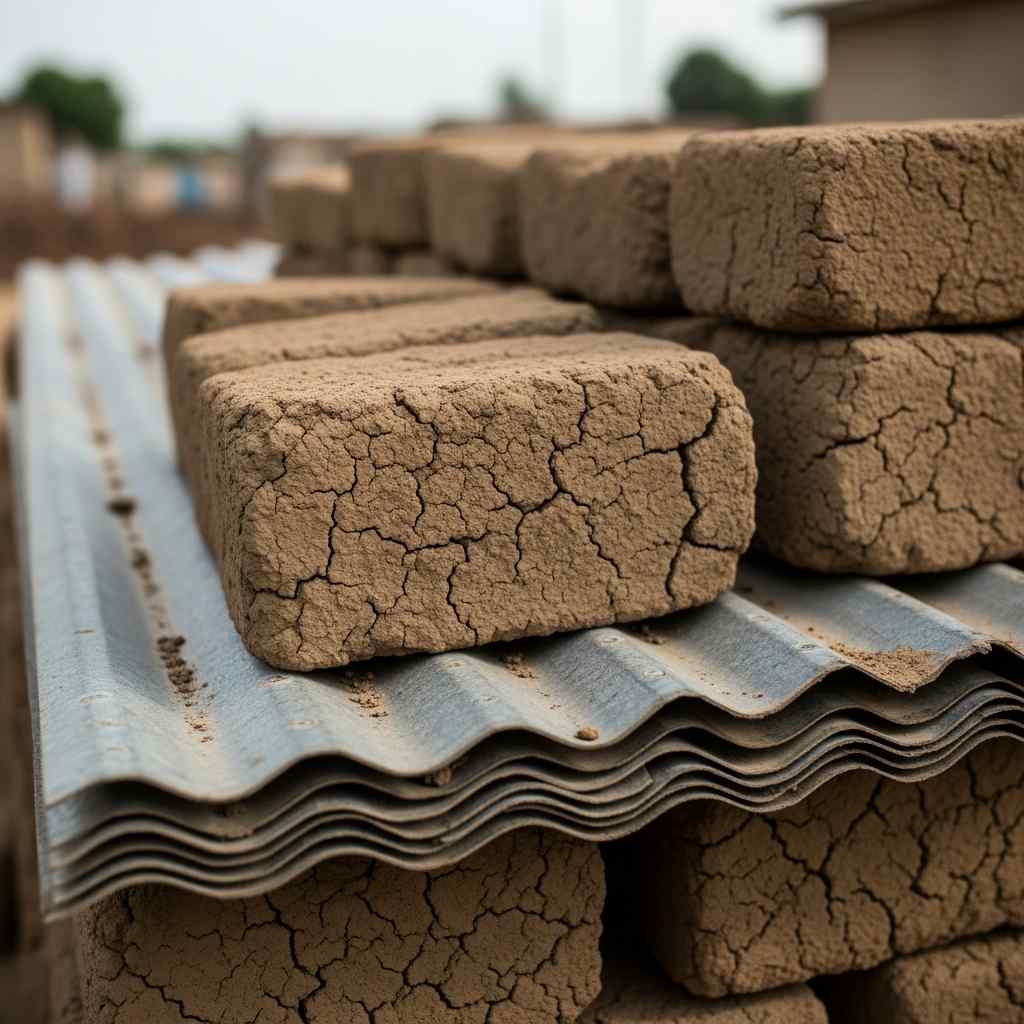
Look at the rooftops in any Nigerian suburb. You will see a sea of corrugated iron sheets, often called ‘zinc’. They are popular because they are lightweight, uncomplicated to install, and relatively cheap. The price depends on gauge thickness and coating.
Data from market surveys in January 2026 show prices. A standard 0.55mm gauge, stone-coated sheet sold for about N4,800 per square meter. A simpler, galvanized sheet of the same gauge was about N3,200 per square meter. Aluminium sheets are more expensive. The lifespan is a factor. A quality stone-coated sheet can last 40 years. A fundamental galvanized sheet may start rusting in 10 to 15 years without maintenance. The cheaper upfront cost requires this long-term consideration.
Where timber fits in the budget
Timber for roofing, door frames, and windows is a major budget line. The price is a function of wood type, treatment, and dimension. Local hardwoods like iroko and mahogany are durable but expensive due to scarcity.
Softwoods and imported pine are common for roof rafters. A 2″ x 4″ piece of treated pine, 12 feet long, sold for between N2,500 and N3,500 in early 2026. Prices are higher in the south where demand from coastal construction is strong. The Ministry of Environment and state forestry departments issue regulations on logging. These regulations affect supply and price. A builder in Benue State has easier access to timber than a builder in Borno State. Transport costs define the final price at the site.
The cement question is unavoidable
You cannot discuss building materials without cement. It is the binder for blocks, mortar, and concrete. As stated, the average price was N7,500 per 50kg bag in Q1 2026. This is a national average with wide disparities.
In some northern states, prices reached N8,200 due to transport from southern factories. The Cement Manufacturers Association of Nigeria releases production data. Local production capacity exceeds 60 million metric tonnes annually. Logistics and distribution explain the price differences, not scarcity. Premium Times reported in March 2026 that the federal government was reviewing the national cement policy. The goal is to address price disparities. For now, the price at the depot closest to you is the price that matters.
Compare prices in your own area
The most successful step is a local market survey. Prices in the Mushin market in Lagos differ from prices in the Ogige market in Nsukka. A call to three block moulders, two timber sellers, and a major hardware store gives a reliable picture.
Create a straightforward table. List each material, the unit, and the price from three different suppliers. This exercise takes an afternoon. It reveals the actual cost in your specific location. It also introduces you to potential suppliers. This local knowledge protects you from inflated quotes. A contractor might claim a bag of cement costs N8,500. Your survey shows the prevailing price is N7,800. You have a basis for negotiation before the first block is laid.
Consider the total cost, not just the unit price
A cheap material that requires expensive skilled labour to install loses its advantage. Bamboo is inexpensive, but a carpenter familiar with bamboo joinery may charge more. Laterite blocks are cheap, but a bricklayer used to sandcrete may work slower with them.
Factor in durability. A roofing sheet that lasts 15 years instead of 40 years means a replacement cost down the line. That future expense is part of the total cost of the building. The cheapest option today may incur higher costs tomorrow. The National Building Code recommends standards for material use. While adherence is sometimes lax, the code provides a reference for durability and safety. A material that fails quickly or compromises safety has a high ultimate cost.
Blend materials for strength and savings
Current construction often uses a hybrid approach. Load-bearing walls might use sandcrete blocks. Internal partition walls could use lighter, cheaper materials like bamboo board or plasterboard. The roof structure could combine timber trusses with bamboo purlins.
This method optimizes the budget. It uses stronger, more expensive materials where they are structurally necessary. It uses lighter, cheaper materials for non-load-bearing functions. The overall cost reduces without sacrificing integrity. Architects and builders with experience in sustainable design promote this approach. It requires more planning at the design stage. The payoff is a practical house built within a realistic budget, using the cheapest building materials in Nigeria where they make sense.
Your next move is a market visit
Gather current prices from your local suppliers this week. Start with the fundamental list: cement, sand, granite, blocks, roofing sheets, and timber. Speak with the sellers. Ask about price trends for the last six months. Their insight is as valuable as the quoted price.
With this information, you can draft a preliminary bill of quantities. You will understand which materials offer real value in your area. You move from general advice to specific, actionable data for your project. This is the foundation of cost control. The dream of building a house persists despite economic pressures. Knowledge of material costs turns that dream into a feasible plan. The prices change, but the principle remains true. The most affordable material is often the one sourced wisely, with full awareness of the local market reality.
I Thought Building A Refinery Was Suppose To Be Everyone’s Pride In Nigeria, Dangote









Thunder speaks sentences that elderly women in one village understand clearly

River Disappears Overnight in Warri Delta State

Market Woman Predicts Deaths in Owerri Through Yam Shapes

Forest healer cures blindness using leaves from a plant found nowhere else

Ancient Wall Repairs Itself in Zaria After Heavy Rains

Confluence refuses to mix after a photographer insulted the local river spirit

Church roof collapses mid sermon and every person inside walked out without injury

Tailor Sews Identical Dress from 40-Year-Old Bible Photo in Asaba

Twins Share Single Heartbeat Born Years Apart

Tomi Adeyemi Film Deal Changes Nigerian Storytelling

Lola Shoneyin Builds a Literary Continent at Aké Festival

ADC Leads #OccupyINEC Protest in Abuja Over Party Derecognition

Internet Sovereignty: Why Some Countries Want Their Own Separate Internet

The Story Of The Nigerian Who Helped Build Global Internet Systems

Nigerian Hackers: The Global Fraud Story and Its Fallout

Forgotten Satellites Defy Silence, Beaming Signals for Decades

Your Digital Store in Nigeria and the Reality of Domain Expiration

The Phone Stay So Quiet: An Investigation into Nigeria’s Silent Customer Lines

The Business That Died: A Nigerian Case Study in Refusal to Adapt

Hiding Your Business From People With Money

How Nollywood Grew Without Government Support

Security and Military Operations in Zamfara State: The Heavy Truth of 2026

Nigeria Produces 67 Percent Global Yam Output

Comedy Industry in Nigeria and Its Economic Contribution


 Digital Sovereignty2 months ago
Internet Sovereignty: Why Some Countries Want Their Own Separate Internet
- Diaspora2 months ago
The Story Of The Nigerian Who Helped Build Global Internet Systems
- Crime2 months ago
Nigerian Hackers: The Global Fraud Story and Its Fallout
- Space Technology2 months ago
Forgotten Satellites Defy Silence, Beaming Signals for Decades
- E-Commerce2 months ago
Your Digital Store in Nigeria and the Reality of Domain Expiration
- Edutech Portal2 months ago
The Phone Stay So Quiet: An Investigation into Nigeria’s Silent Customer Lines
- Edutech Portal2 months ago
The Business That Died: A Nigerian Case Study in Refusal to Adapt
- Business2 months ago
Hiding Your Business From People With Money