Border Security
How Insurgents Turned Wedding Drones Into Weapons of War
Here is the thing. Wedding drones now carry bombs. So here we are. Insurgents found a cheap, smart weapon. They fly across borders. What stops them? Not just soldiers. Fix the economy. That is the real answer.

How Insurgents Turned Wedding Drones Into Weapons of War
Published: 14 March, 2026
Something shifted in March 2023. Security analysts documented what military commanders had feared for years: Jihadist groups across West Africa now carry out drone strikes with growing frequency. The BBC News Africa service reports that these groups are building capacity for what some call a “war from the skies.”
The numbers tell the story. ACLED data indicates that Jama’at Nusrat al-Islam wal-Muslimin (JNIM), an al-Qaeda affiliate in Burkina Faso and Mali, has carried out at least 69 drone strikes since 2023. Two Islamic State affiliates have carried out approximately 30 such strikes.
Most hit Nigeria. This is a country that has fought insurgent groups like Boko Haram and ISWAP for more than 25 years.
The Ordinary Gadget That Became a Weapon
Here is the thing about drones. A drone flies without a human pilot inside. Someone on the ground controls it remotely, or computers fly it using GPS and programmed routes.
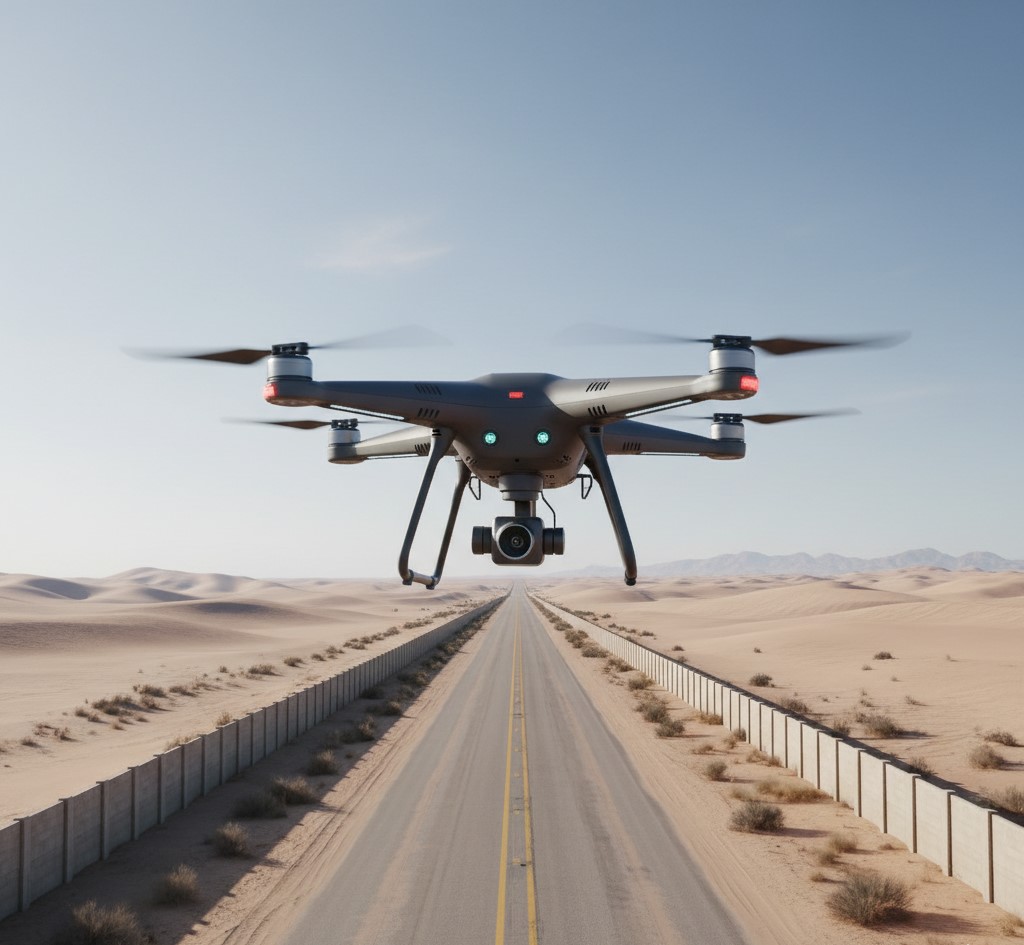
The drones causing trouble are quadcopters. They use four spinning blades to hover and move. Young men fly the same ones to shoot wedding videos in Lagos.
You can buy them openly at Computer Village and Alaba International Market. Premium Times documented this in a 2025 investigation into smuggling routes across West Africa. The shops sell them as toys or tools for photographers.
The jihadists buy the same gadgets and turn them into weapons. The Armed Conflict Location and Event Data Project (ACLED) says they rig commercially available quadcopters with explosives. They also use them for reconnaissance and surveillance before ground attacks.
Reconnaissance means spying. Surveillance means watching continuously. The International Institute for Strategic Studies noted in a 2025 report that both activities give insurgents better intelligence than they ever had before.
The government of Nigeria controls the import of commercial drones tightly. You need official permission to use one. But the jihadists get theirs through smuggling networks.
The United Nations Office on Drugs and Crime says these networks operate across porous regional borders where monitoring is weak and enforcement proves difficult.
Think about Alaba International Market. Nothing stops a trader from selling multiple units to someone who might be an insurgent scout. The trader sees a customer buying goods.
The destination of those goods remains invisible. Security analyst Audu Bulama Bukarti explained this to the BBC.
What the Numbers Show About Drone Attacks
These are probably off-the-shelf first-person view models, called FPV drones. The operator wears special goggles that show exactly what the drone camera sees. It feels like sitting inside the drone while flying. Drone Industry Insights described this in a technical report.
The most recent major attack happened in north-eastern Borno State on 29 January 2026. Jihadists launched a two-pronged assault using multiple armed drones and ground fighters against a military base. The military confirmed that nine soldiers died in the ISWAP attack, according to a statement from Operation Hadin Kai cited by Premium Times.
ACLED data shows ISWAP has carried out at least 15 drone strikes since 2024 across north-eastern Nigeria, northern Cameroon, southern Niger, and southern Chad. Another IS affiliate called the Islamic State of Sahel Province (ISSP) has carried out a similar number of drone attacks in West Africa.
On the same day, ISSP attacked the international airport in Niamey, the capital of Niger, and nearby military bases. The defence ministry of Niger reported that four military personnel suffered injuries and 20 assailants died, as reported by Agence France-Presse.
The group that has used drones most frequently is Jama’at Nusrat al-Islam wal-Muslimin (JNIM). ACLED says JNIM has carried 69 strikes in neighbouring Mali and Burkina Faso, plus one across the border in Togo.
The JNIM drone programme has grown rapidly. It spread through interconnected networks in Mali and Burkina Faso. In February 2025, JNIM used first-person view drones to drop improvised explosive devices made from plastic bottles onto military positions in Djibo town in Burkina Faso. This was according to a report from the Centre for Strategic and International Studies.
An improvised explosive device (IED) is a homemade bomb. Plastic bottles filled with explosives and shrapnel become weapons when dropped from drones, as explained in a United Nations Security Council report on terrorist tactics.
This represented a major escalation. FPV drones are small and agile. They allow precise targeting. The operator can guide the drone directly into a target with accuracy that crude methods never permitted. Drone warfare expert James Rogers made this point.
Where They Learned These Techniques
Foreign fighters influenced and trained the jihadist groups to adopt new methods constantly. This was according to a 2025 report from the International Crisis Group. They moved from making roadside bombs and suicide belts to turning off-the-shelf drones into weapons.
Roadside bombs have been a favoured tactic for years. Suicide belts are vests packed with explosives worn by individuals who detonate themselves in crowded places, as documented by the Combating Terrorism Center at West Point.
Most JNIM drone attacks in Mali and Burkina Faso have targeted the military and allied militias. But there is a catch. Some have hit civilians. Markets in communities perceived as aligned with government forces have been struck, killing ordinary people going about their daily business, according to Human Rights Watch.
ISWAP carried out at least one drone attack that hit civilians in June 2025. Two pastoralists died and one suffered injuries in northern Cameroon, according to data collected by ACLED.
“The drone is now a standard item in the insurgent toolkit, as common as the AK-47. It has changed the geometry of the battlefield in the Sahel.” , Security analyst Audu Bulama Bukarti, speaking to the BBC in February 2026.
Why Border Security Belongs to an Older Era
The Nigeria Immigration Service, the Nigeria Customs Service, and the military carry primary responsibility for border security. The structure and equipment of these agencies focus on ground threats involving people. Security personnel call these terrestrial threats, according to a 2025 briefing by the National Defence College of Nigeria.
Terrestrial means relating to land. Smugglers carrying goods. Insurgents walking through the bush. Vehicles crossing illegally at unapproved points.
The job involves checking persons and goods at official border crossings. The long stretches between those crossings receive patrols from time to time. But persistent monitoring and constant watching remains absent in those areas. This is particularly true for low-altitude airspace, according to a report from the Nigeria Security Network.
Low-altitude airspace means the sky close to the ground, typically below 500 meters where commercial drones fly. This is a new dimension of border security that existing systems were never designed to handle. The Centre for Democracy and Development noted this in a 2026 report.
The system for national airspace surveillance belongs to the Nigerian Airspace Management Agency (NAMA) and the Nigerian Civil Aviation Authority (NCAA). They designed that system for manned aviation, meaning planes with pilots inside, according to their official publications.
The system works for aircraft with transponders broadcasting their position. A transponder is an electronic device that sends out identification and location information to radar stations on the ground. It tells air traffic controllers exactly where each plane is and who it belongs to, as explained by the International Civil Aviation Organization.
Drones lack transponders. Drones fly low, below the coverage of standard radar systems. The system fails to see them at all.
They are invisible to the technology designed to track aircraft, according to a technical assessment by Thales Group.
This gap creates vulnerability. A drone flying 100 meters above ground can cross from Niger into Katsina State or from Cameroon into Borno State without triggering any alert. A simulation conducted by the Nigerian Army School of Infantry confirmed this.
No alarm sounds. The security architecture is silent.
The Regional Picture and Recent Events
A significant incident occurred on January 6, 2026. An apparent military drone strike in Niger killed at least 17 civilians, including four children, and injured at least 13 others at a crowded market in western Niger, according to Human Rights Watch. The attack took place in the village of Kokoloko in the Tillabéri region, about 120 kilometers west of the capital, Niamey.
The village sits less than three kilometers from the border with Burkina Faso. This shows how drone operations ignore lines drawn on maps.
Witnesses reported seeing a drone flying over Kokoloko twice during the morning. At about 1:30 p.m., when hundreds of people packed the market for weekly trading, the drone dropped munitions on the village. Three Islamist fighters from the Islamic State in the Sahel also died in the strike, according to a report from Reuters.
This event was a military strike by Niger, not Nigeria. Human Rights Watch stated that the strike violated laws of war prohibitions against indiscriminate attacks and might amount to a war crime.
The Nigerien military junta, which took power in a July 2023 coup, issued no public comment following the drone strike, according to Al Jazeera. This tragic error fails to diminish the confirmed threat of insurgent drone attacks. But it must be correctly attributed to the proper country.
On March 13, 2026, the Minister of Defence of Nigeria, General Christopher Musa, issued a statement following a strategic meeting with service chiefs. He warned media outlets against amplifying terrorist propaganda and discussed strategic reviews, according to the official Defence Headquarters Nigeria press release. He never made the specific “AK-47” drone comparison sometimes attributed to him on social media.
Where the Money Comes From
The money for these drones comes from established revenue streams. points to two main sources: First, ransom payments from kidnap victims. Second, taxation of illicit cross-border trade. A 2025 report from the Financial Action Task Force confirmed this.
Ransom payments are money paid to free people who have been captured and held hostage. Kidnapping for ransom has become a lucrative business for insurgent groups, funding their operations including drone purchases, according to the Global Initiative Against Transnational Organized Crime.
Illicit means illegal. Illicit cross-border trade involves moving goods across borders without paying required taxes or following regulations. Cattle smuggled across borders. Fuel smuggled across borders. Grains smuggled across borders. All face taxation by the insurgents who control territory along smuggling routes, according to a study by the Institute for Security Studies.
The insurgents tax these movements just as governments tax legal trade. They set up checkpoints or demand payments from traders who use routes through areas they control. The money collected buys drones for their programmes, as documented in a 2026 report from the United Nations Institute for Disarmament Research.
The investment shows strategic thinking. The return comes in better operations and lower risk to their people. Spending money on drones reduces the need to send fighters on dangerous ground missions where they could die. Terrorism finance expert Dr. Monday E. Akpan argued this in a paper for the Nigerian Institute of International Affairs.
In response to kidnapping as a funding mechanism, the government of Nigeria established the Multi-Agency Anti-Kidnap Fusion Cell in December 2024. This happened in collaboration with the National Crime Agency of the United Kingdom, according to a joint press release from both governments.
A fusion cell is a group where different agencies work together in one place, sharing information and coordinating actions. The Multi-Agency Anti-Kidnap Fusion Cell brings together police, military, intelligence, and other security personnel to fight kidnapping, as explained by the Office of the National Security Adviser.
The Cell has since contributed to several breakthroughs. It aided rescue missions. It disrupted criminal networks. It improved intelligence sharing among multiple security agencies of Nigeria, according to a progress report presented to the National Assembly of Nigeria in February 2026.
In August 2025, the National Counter Terrorism Centre expanded the operations of this Cell across state commands nationwide. The initiative aims to build an operational bridge between the Fusion Cell and state security structures, according to a circular from the Office of the National Security Adviser.
How the World Fights Back
Counter-drone technology grows fast around the world. The technical name is Counter-Unmanned Aircraft Systems (C-UAS). The solutions divide into two types: kinetic methods using physical force and non-kinetic methods using electronics, according to a comprehensive study by the RAND Corporation.
Kinetic methods include nets fired from special launchers that capture drones. They include lasers that burn through drones by focusing intense heat on a small spot. They include missiles that blow drones out of the sky with explosions, as described in a report by the Center for the Study of the Drone at Bard College.
Non-kinetic methods use electronics instead of physical force. Radio frequency jamming sends out signals that interfere with communication between the drone and its operator. This causes the drone to lose contact and either land or return to its starting point, according to a technical paper from the Institute of Electrical and Electronics Engineers.
GPS spoofing feeds false location data to confuse the drone. Spoofing means tricking the drone into thinking it is somewhere else, causing it to fly off course or land in a different location, as explained by Dr. Todd Humphreys of the University of Texas at Austin.
The best systems layer these approaches. Radar detects incoming drones. Electro-optical sensors identify drones by using cameras and computer software to recognise their shapes. Electronic warfare neutralizes them by jamming or spoofing, according to a product catalogue from Leonardo S.p.A.
The Department of Homeland Security of the United States tested such systems along its borders with Mexico and Canada, according to a report from the U.S. Government Accountability Office. European nations deploy them around critical infrastructure.
For Nigeria and its neighbours in ECOWAS, cost and complexity raise significant barriers. A fixed-site C-UAS system with all available features can run millions of dollars per unit, according to a market by Frost and Sullivan.
Mobile systems for patrol units cost less but still require significant investment. Technical expertise to operate and maintain them adds another layer of constraint. The African Union Peace and Security Council noted this in a 2026 report.
The alternative involves shooting at drones with rifles. But that method fails most times because drones are small, fast, and hard to hit. The bullets must come down somewhere after missing their target or passing through the drone.
Falling rounds kill civilians and kill friendly forces, according to a study by the Small Arms Survey.
What the Experts Recommend
West African armies need to carry out preemptive strikes to destroy drone assembly and launch sites, according to a recommendation from the Lake Chad Basin Commission. Preemptive means acting before the enemy can act.
They also need to acquire more counter-drone technology, including jamming devices and air defence systems. The United Nations Office for West Africa and the Sahel stated this in a 2026 report.
Otherwise, the jihadists could strengthen their drone warfare capabilities and carry out high-impact assaults that worsen instability in West Africa. This was a warning from the International Crisis Group.
African states should adopt a Turkish model for countering drone threats from non-state armed groups, according to a policy paper from the Africa Center for Strategic Studies.
The Turkish model involves reducing reliance on imported, pre-made drone technologies and investing in state-backed research, development, and local production, according to a case study by the Stimson Center. Turkey built its drone industry by funding local companies, most notably Baykar Technologies.
Nigeria and other African countries have a growing number of start-ups developing drone and autonomous systems. Examples of Nigerian tech start-ups include Briech UAS and Terra Industries, as profiled by TechCabal.
Terra Industries has reportedly raised £8.6 million through an entity linked to Palantir Technologies, according to filings with the Corporate Affairs Commission of Nigeria. This investment shows that international capital sees potential in Nigerian drone technology.
These firms should receive support through targeted state funding, as Turkey did with Baykar Technologies, according to a recommendation from the Nigerian Economic Summit Group.
If Nigeria treats drone and autonomous weapons systems as a strategic national security priority, it should invest directly in several local firms as part of a wider defence-industrial policy. A 2025 white paper from the Nigerian Ministry of Defence argued this.
Protecting lives and property is a core duty of the state. Investing in local drone technology serves this duty by providing better tools for security forces while also building Nigerian industrial capacity, as argued by Dr. Oshita Oshita, Director-General of the Institute for Peace and Conflict Resolution.
A practical step
The size of this problem calls for a systemic response. But action can start with focused steps building on what already exists, according to security sector reform expert Dr. Chris Kwaja of the Centre for Democracy and Development.
This analyst recommends that the government of Nigeria consider expanding the mandate of existing fusion cell structures to include drone incident coordination.
The Multi-Agency Anti-Kidnap Fusion Cell demonstrates how real-time intelligence and operational readiness can be effectively coordinated across state commands, according to a progress report presented to the National Assembly of Nigeria.
A similar model applied to drone incidents could create the common operating picture that security forces desperately need, according to a concept paper from the Nigerian Army Headquarters.
Under such a model, every sighting by a soldier would enter a central database. Every report from a border community would enter. Every intercepted signal would enter.
Patterns would emerge that individual units cannot see on their own. Common launch sites would become visible. Frequent flight corridors would appear. Times of activity would cluster together, showing when attacks are most likely.
This intelligence would become the foundation for effective counter-operations. It tells commanders where to deploy limited counter-drone assets for maximum effect. It provides evidence for budget requests. It guides talks on regional cooperation with hard data, according to a simulation exercise conducted by the Defence Intelligence Agency.
The cost of enhanced coordination amounts to a fraction of a major weapons system. The potential to disrupt the new drone warfare carries serious strategic weight.
Looking forward
The technology available to insurgents will keep advancing. Ukraine has shown how access to cheap FPV drones can narrow the advantage held by better-equipped state forces, according to a report from the Royal United Services Institute.
A similar pattern could emerge in Nigeria unless the armed forces adapt quickly to the spread of drone-enabled insurgency. General Lucky Irabor (retired), former Chief of Defence Staff, gave this warning at a security conference in Abuja.
The next horizon involves autonomous drone swarms with multiple drones operating together, according to a report from the United Nations Institute for Disarmament Research.
Open-source software for basic swarm coordination already exists online, according to researchers at the Massachusetts Institute of Technology. While current insurgent operations probably lack this capability, the direction points toward more complex systems.
For security along the borders of Nigeria, the future demands a new way of thinking about the border itself. The border no longer functions as a line on the ground that soldiers can watch with binoculars and patrol with vehicles, according to a concept paper from the Nigerian Army School of Infantry.
The border exists as a three-dimensional volume of airspace requiring monitoring and control. The airspace above the border requires watching just as carefully as the ground itself, according to air power expert Dr. Olumide Ojo of the Nigerian Defence Academy.
This demands investment in a sensor layer comprising a network of radar, acoustic, and radio frequency sensors along vulnerable border segments, according to a technical recommendation from Thales Group Nigeria.
It requires equipping patrol units at the border with portable devices for drone detection and mitigation, according to a procurement proposal submitted to the National Assembly of Nigeria.
It requires training programmes for security personnel on identification of drones and reporting protocols, according to a curriculum developed by the Clearing House for Security Sector Governance.
The response of the military of Nigeria to the emerging drone-enabled insurgency will determine how insecurity worsens in the country, according to Dr. Freedom C. Onuoha of the University of Nigeria, Nsukka.
Without rapid investment in counter-drone capabilities and stronger intelligence, Nigeria risks losing operational advantage in its counter-insurgency campaign.
The rise of drone use by insurgents represents technological disruption in warfare. The state once held an absolute monopoly on capability for aerial surveillance and strike, according to a historical by the International Institute for Strategic Studies.
A consumer gadget broke that monopoly. A gadget that costs less than a Bajaj motorcycle, available in any electronics market, now gives insurgents capabilities that once belonged only to air forces. Bloomberg Opinion noted this in a commentary.
The response demands innovation in technology, agility in policy, and urgency in cooperation. A communiqué from the ECOWAS Heads of State Summit held in February 2026 stressed this point.
The security of the borders of Nigeria now depends on winning a contest fought on the ground and in the low-altitude skies above it. The outcome of this contest will determine the safety of millions of Nigerians living in border communities and the stability of the entire West African region, according to a report from the United Nations Development Programme.









Border Security
Border Technology Requires Investing in Surveillance Equipment to Monitor Remote Frontier Areas
Here is the thing. Our borders stretch for miles. Much of it is empty. So how do you watch it? You invest. Border technology means cameras, sensors, eyes where we have none. It is not simple. But it is necessary. So here we are.
Border Technology Requires Investing in Surveillance Equipment to Monitor Remote Frontier Areas
Published: 17 March, 2026
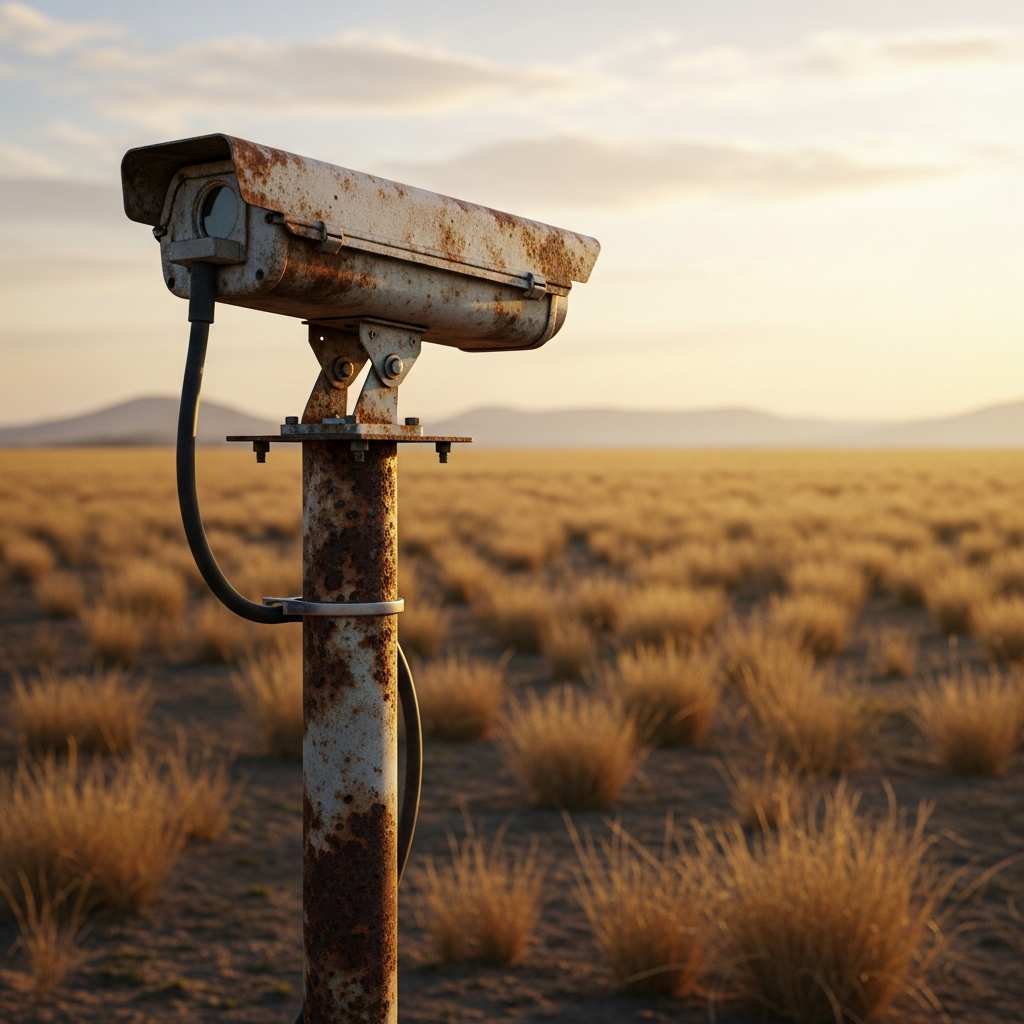
Imagine securing a line 4,047 kilometers long. That is roughly the road distance from Lagos to Algiers. A recent report from the Nigeria Immigration Service states that approximately 1,500 kilometers of that line is classified as “porous” and largely unmonitored. To confront this, the government has allocated N5.93 trillion for defense and security in the 2026 budget. The trouble is, the specific portion for border technology and surveillance infrastructure is lost within that massive sum.
You have a country flanked by instability. To the north, the Sahel region burns. To the west, the Gulf of Guinea teems with smugglers. The official response involves patrols and closures. The physical reality involves vast, empty spaces where a handful of personnel monitor territories the size of small countries. The Comptroller-General of the Nigeria Customs Service, Adewale Adeniyi, framed the challenge in February 2026. He said manpower alone is insufficient.
“The future of border management lies in technology. We are transitioning from a manual, labor-intensive process to an automated, intelligence-driven system. This shift is non-negotiable for national security and economic prosperity.” Adewale Adeniyi, Comptroller-General, Nigeria Customs Service, speaking at a policy forum in Abuja, February 2026.
The argument for tech is straightforward. Drones, cameras, and sensors provide constant eyes. They generate data on movement. That data lets security agencies deploy their limited people with precision. A 2024 pilot project by the Office of the National Security Adviser in Katsina State proved the point. Using drone surveillance, they identified and disrupted 27 illegal crossing points in three months. It was a model. Scaling it nationally is the multi-billion naira question.
Here’s the thing about the money
Investment in border technology competes with everything, salaries, subsidies, debt. The 2026 Appropriation Act allocates funds to the Renewed Hope Infrastructure Development Fund. A fraction could finance a national surveillance grid, but the political will to spend on invisible infrastructure, rather than visible roads, is a separate calculation.
Procurement is another layer. The history of government tech acquisitions is mixed. Systems arrive, maintenance contracts lapse, training fails, spare parts vanish. As Premium Times found in a 2023 investigation, billions of Naira worth of security and communications gear bought between 2010 and 2020 was simply inoperable due to neglect. Any new investment must include a sustainable plan for upkeep. That doubles the long-term cost.
Why drones and sensors are only part of the answer
High-tech gear generates terabytes of data daily. Without analysts to interpret it, the feeds are useless. The Nigeria Customs Service has about 15,000 officers. The Nigeria Immigration Service has about 25,000. These numbers are static. Data from a full surveillance network would grow exponentially.
The solution? A dedicated Border Surveillance and Data Command Centre. It would integrate all feeds and employ data scientists. This creates a secondary funding need: salaries for skilled technicians. The Ministry of Communications, Innovation and Digital Economy has a mandate to train 2 million technical talents by 2027. A focused stream within that for border security analytics could plug the human gap.
“Technology is a force multiplier, but it is not a silver bullet. It must be embedded within a broader strategy of community engagement, regional cooperation, and economic development in border regions. A camera cannot negotiate, it can only observe.” Dr. Kabiru Adamu, Security Analyst and Managing Director of Beacon Consulting, in an interview with The Cable, January 2026.
The local economy at the borderline
Communities along the frontier depend on cross-border trade. This trade often operates outside official channels. A heavy-tech lockdown without alternatives would crush them. The National Bureau of Statistics reported that informal cross-border trade with Niger, Cameroon, Chad, and Benin was worth over $4 billion yearly before the 2020 border closure. A smart system should facilitate legitimate trade while filtering illicit activity. This means integrating surveillance with processing at official posts.
There’s a prerequisite. The World Bank approved a $500 million credit for the Nigeria Digital Identification for Development Project in 2024. A secure digital ID is essential. It allows for biometric verification. Without it, surveillance systems can track movement but cannot reliably identify individuals. The pace of the national ID rollout directly impacts the effectiveness of every naira spent on border tech.
A closer look
Nigeria does not secure its borders in a vacuum. The Economic Community of West African States has a free movement protocol. The African Continental Free Trade Area wants reduced barriers. A fortress mentality with high-tech walls contradicts these agreements. The strategy needs diplomacy. Nigeria could lead a consortium of neighbors to adopt interoperable tech standards. Shared data on terrorist movement benefits everyone. The Multinational Joint Task Force in the Lake Chad region is a model for joint operations that could extend to joint surveillance.
Contrast this with examples. Ghana has a National Electronic Border Management System. Kenya uses drones on its Somalia border. A 2025 study by the Institute for Security Studies in Pretoria analyzed six African projects. It found that projects with direct community involvement and economic benefits for residents had higher success rates, and lower rates of equipment sabotage.
The path forward has a logical start. The government, through the Ministry of Interior and the Office of the National Security Adviser, should commission and publicly release a National Border Surveillance Technology Blueprint. This document would map every kilometer. It would classify terrain and specify the tech needed for each segment: tower cameras for plains, drone fleets for forests, ground sensors for mountains. It would provide a transparent, phased budget for acquisition, installation, training, and maintenance over five years.
This blueprint would move the conversation from abstract advocacy to a concrete, costed plan. It would allow for scrutiny. It would give international partners a framework. Most importantly, it would create a baseline for accountability. Citizens could track, year by year, how many kilometers of porous border became monitored. In a country where grand plans often dissolve, a simple, public map with measurable goals is a small, doable action. The security of the nation depends on knowing who and what crosses its lines on the map. In 2026, that knowledge is digital. The investment is not just in cameras and drones, but in the sovereign capability to see.
Nigerian customs eyes Blockchain technology , CNBC Africa. (Digital Illustration: GoBeyondLocal)
Border Security
Regional Cooperation as a Military Imperative for Nigeria
Here is the thing. Borders are lines on maps. Threats ignore them. So Nigeria must work with neighbors. Joint patrols. Shared intelligence. It is not just policy. It is survival. What happens when we stand alone? We know the answer.
Regional Cooperation as a Military Imperative for Nigeria
Published: 17 March, 2026
Look at the 2026 defence budget. Buried in the line items is funding for joint military exercises with neighbours. A decade ago, that was theory. Today, it is daily routine. As The Guardian Nigeria noted this year, the platform run by the Ministry of Defence now lists at least five active multinational security pacts involving our armed forces. The idea of a purely national defence is gone.
Threats move. They cross lines drawn by colonial cartographers with contempt for geography. A soldier in Borno watches a drone feed from an aircraft operated by the air force of Niger. In Lagos, a naval officer coordinates with counterparts from Ghana and the Benin Republic. This is the unglamorous reality of regional cooperation.
But there is a catch.
So what is really going on with our borders?
The map of West Africa shows 16 countries. The map used by insurgents and traffickers shows one contiguous zone. The collapse of state authority in the Sahel, in Mali and Burkina Faso, created a vacuum. Groups like Jama’at Nusrat al-Islam wal-Muslimin and the Islamic State West Africa Province treat borders as minor inconveniences.
Movement follows ancient trade routes, not modern checkpoints. A 2025 report from the Institute for Security Studies described a cascade of instability, where conflict in one nation spills into its neighbours. For Nigeria, this means the threat is no longer confined to the Northeast. Banditry in the Northwest links to dynamics in the Niger Republic. Piracy in the Gulf of Guinea demands a response covering the waters of multiple states.
The Chief of Defence Staff, General Christopher Musa, stated it plainly in 2025: “the enemy we face recognizes no sovereignty. Our response, therefore, must be collective.” This reflects a doctrinal shift. The focus has moved from defending territory to securing a region.

The Lake Chad Basin: A laboratory for joint operations
The most established framework is the Multinational Joint Task Force. Troops from Nigeria, Niger, Chad, and Cameroon operate in the volatile Lake Chad Basin. A 2025 United Nations Development Programme assessment noted the MNJTF conducted four major coordinated operations in eighteen months, neutralizing hundreds of insurgents.
Its operational headquarters rotates. This forces constant integration of command and intelligence. Cooperation extends beyond combat. Nations share real-time surveillance data from drones. Joint border patrols are routine, though plagued by incompatible radios and differing rules of engagement.
The trouble is funding. Member states are sometimes slow to pay. The force leans heavily on the European Union and other partners. Yet, it stands as the primary regional military answer to a regional problem. Its existence admits a hard truth: no single country here can secure its own shoreline, let alone the entire lake.
“We have moved from occasional meetings to a permanent fusion of effort. The terrorist in Diffa is the same as the terrorist in Dikwa. Our operations reflect that reality.” A senior Nigerian officer serving with the MNJTF, speaking anonymously in December 2025.
Why the Gulf of Guinea needs more than a navy of Nigeria
Maritime security is different. The Gulf of Guinea accounts for most global kidnappings for ransom at sea. Nigeria has the largest navy, with new vessels like the NNS Kada. But a strong national navy has limits in international waters.
The response is the Yaoundé Architecture, a coordination network set up in 2013. It links the navies of ECOWAS and ECCAS states. In 2025, the International Maritime Bureau reported a 40% drop in piracy incidents, crediting improved regional coordination. Nigeria hosts the Multinational Maritime Coordination Centre Zone E in Lagos. Vessels from Nigeria, Benin, Togo, and Niger collaborate.
The economics compel this. Over 90% of the trade of Nigeria by volume moves by sea. Attacks spike insurance costs and cripple the blue economy. A pirate arrested by the navy of Ghana may have intelligence on a cell in the Niger Delta. This interconnected threat makes solitary action useless.
As Rear Admiral Y.B. Wambai said at a 2025 summit: “A safe corridor off Cotonou makes the corridor off Lagos safer. We succeed together or we fail separately.”
The Sahel spillover and the ECOWAS puzzle
This brings us to the hardest test. The Sahel coup belt, Mali, Burkina Faso, Niger. These nations, now under juntas, expelled French forces and turned to Russia’s Wagner Group. ECOWAS suspended them and threatened intervention after the 2023 coup in Niger. That threat collapsed. The ECOWAS Standby Force exists mostly on paper.
Here is the dilemma. Nigeria shares a 1,608-kilometer border with Niger. Instability there fuels banditry in Sokoto, Kebbi, Katsina. Yet, formal military cooperation with the junta is politically untenable.
Wait, it gets more complex. Security sources say communication between field commanders across the border continues, focused on specific threats like fleeing terrorists. This is regional cooperation by necessity. Messy. Unofficial. A 2026 policy brief from the Centre for Democracy and Development warned the of the juntas with Russia creates a new frontier for geopolitical competition. For our armed forces, a former ally becomes a partner of a rival power, yet remains a geographical fact that cannot be ignored.
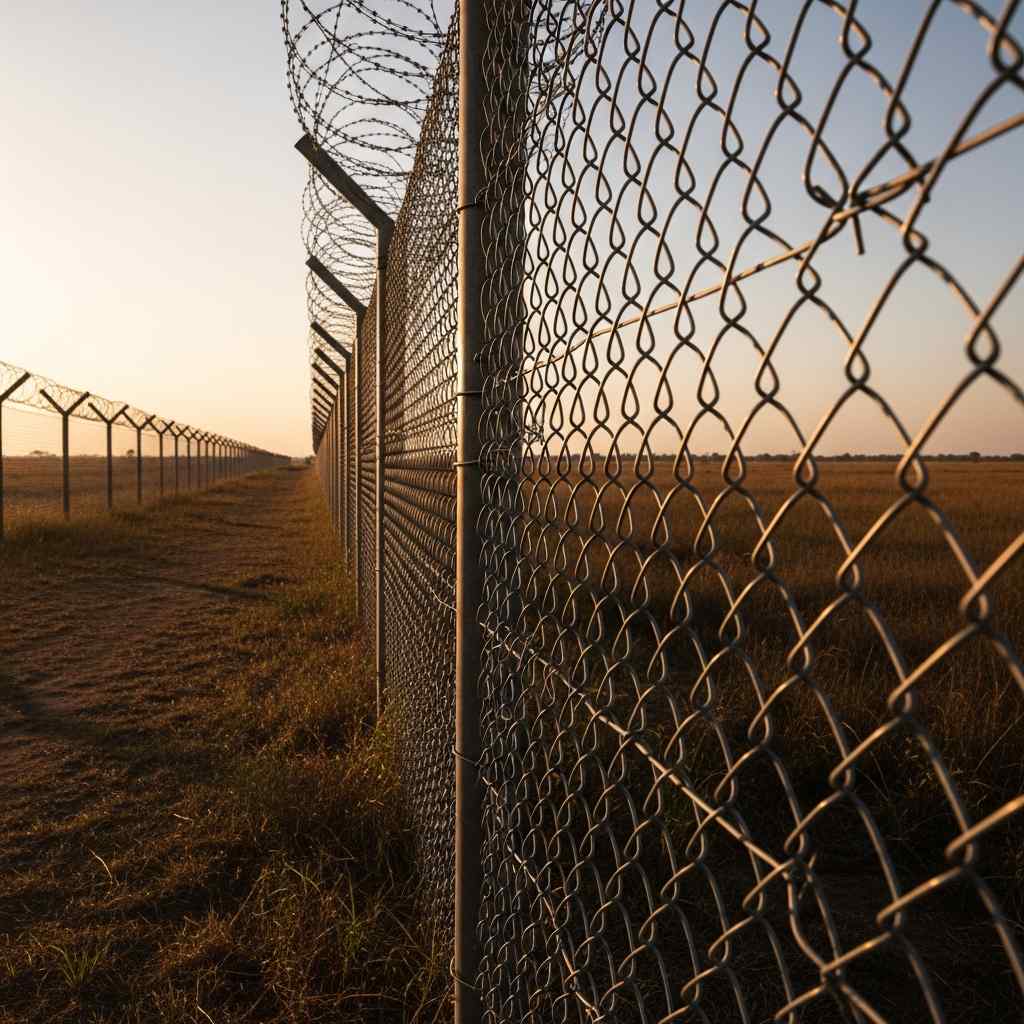
The machinery of talking and working together
Cooperation needs infrastructure. The National Counter-Terrorism Centre in Abuja fuses intelligence from partners. The Nigeria Police Force uses the West African Police Information System. The annual Exercise Obangame Express, sponsored by U.S. Africa Command, trains Gulf of Guinea navies. In February 2026, the air forces of Nigeria and Ghana conducted joint combat training.
These mechanisms face obstacles. Bureaucracy slows intelligence sharing. Donated equipment from the United States or the United Kingdom often has different technical standards. Linguistic differences between Anglophone and Francophone officers cause friction. Funding is a perpetual issue. The budget for international military cooperation is a fraction of what is needed.
Much relies on personal relationships between commanders. A fragile foundation for a long-term strategy.
“The maps in our operations room now have layers from four different countries. Seeing the entire chessboard changes how you move your pieces.” Colonel D. B. Ali, Nigerian Army, speaking after a multinational planning conference in Abuja, January 2026.
The argument for a fortress Nigeria has intuitive appeal. It suggests control. The past fifteen years have demonstrated its fallacy. Our military, the largest in West Africa, deployed over 300,000 personnel. It acquired drones, attack helicopters, armoured vehicles. Yet, threats multiplied.
Insurgents retreated across borders. Bandits used foreign sanctuaries. Pirates exploited jurisdictional gaps. Military strength has limits defined by geography. A battalion cannot pursue a target into another sovereign state without invitation. A warship cannot permanently station in the waters of a neighbour. Regional cooperation is the mechanism that extends reach and legitimacy. It turns a line on a map from a barrier into a bridge.
The alternative is a permanent state of reaction. The cost of isolation is measured in continued bloodshed.
The most immediate step? The National Assembly must hold a public hearing focused exclusively on the international security commitments of Nigeria. Scrutinize the funding, legal frameworks, and outcomes of bodies like the MNJTF and the Yaoundé Architecture.
This moves the discussion from security circles into the public domain. Citizens have a right to understand how collective security works, what it costs, what it achieves. Transparency builds public support. That support gives the government a stronger mandate to invest in these essential partnerships. The security of the region depends on the understanding and will of the people it protects.
Nigeria, US Strengthen Collaboration, Military Cooperation , TVC News Nigeria. (Digital Illustration: GoBeyondLocal)
Border Security
Security Realities on the Nigeria-Niger Border Following the 2023 Coup
Here is the thing. When your neighbor changes guard, you watch your own gate differently. The Niger coup did that. So here we are. Nigerian soldiers now scan a quiet frontier. But quiet can be loud. What does this mean for border communities? The answer is not simple.

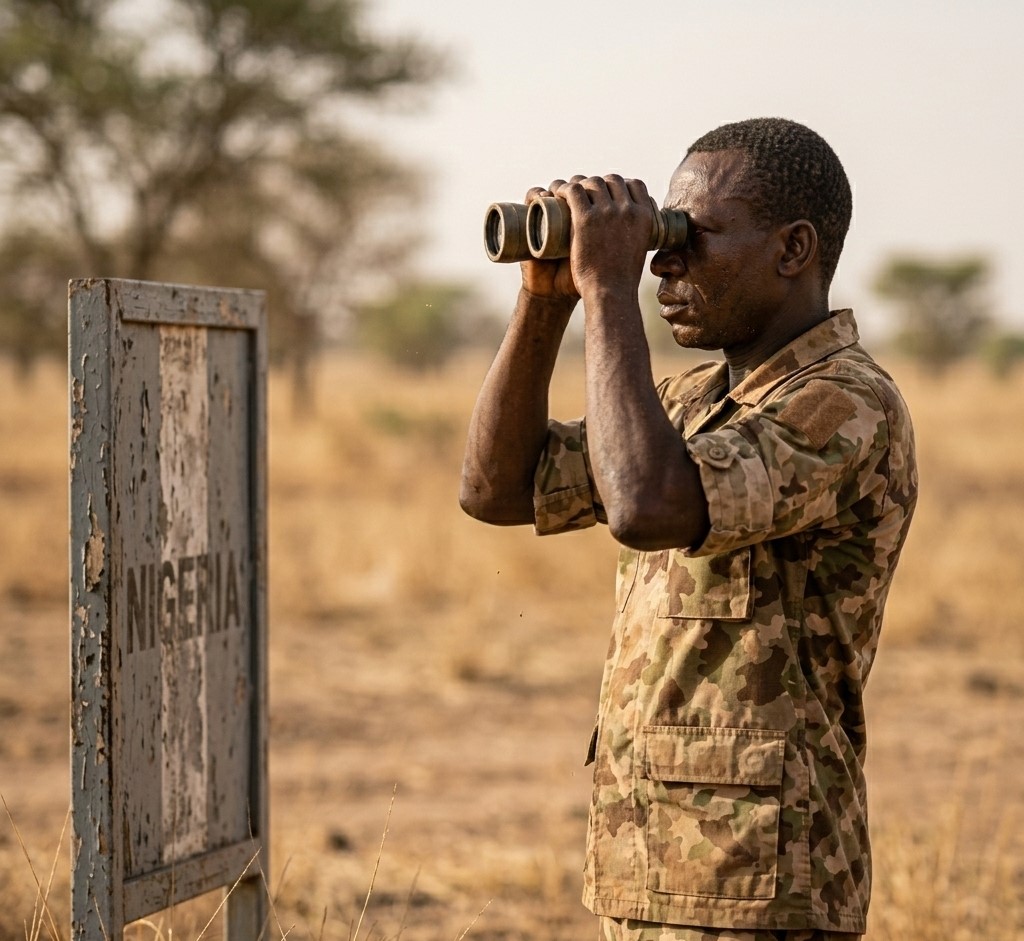
What Happens When the House of Your Neighbour is on Fire?
Published: 01 March, 2026
On July 26, 2023, reports from Premium Times confirmed it. General Abdourahamane Tchiani had led a coup that deposed President Mohamed Bazoum. The security framework along our 1,500-kilometre northern border, built over decades, began to unravel overnight. Joint patrols stalled. The flow of critical intelligence, once routine, slowed to a trickle. As The Guardian Nigeria noted later that year, Nigeria lost a vital early warning system provided by Nigerien forces monitoring the wider Sahel.
The trouble is, borders are more than lines on a map. They are markets, families, and shared history. When ECOWAS, under the leadership of Nigeria, imposed sanctions and closed the border in August 2023, the immediate pain was economic. Vanguard News and Daily Trust documented the paralysis in hubs like Illela and Maigatari. By September, the International Organization for Migration (IOM) recorded thousands moving back across as opportunities vanished.
But there is a catch. While ECOWAS lifted most sanctions in February 2024, some targeted sanctions remained. The political frost between the new Alliance of Sahel States (AES), Niger, Mali, Burkina Faso, and ECOWAS has prevented a full return to pre-coup cooperation. The region is stuck in a state of managed tension.
This brings us to the core security dilemma. The Multinational Joint Task Force (MNJTF), a pillar of regional action, saw its harmony shattered. While relations have been strained, Niger has not formally withdrawn from the MNJTF as of March 24, 2026. The reduced cooperation, however, has forced the hand of Nigeria. We have significantly increased the defense budget for unilateral border patrols. That explains the heightened military presence you see along the frontier today.
The Gaps That Armed Groups Exploit
Without synchronized hot pursuit agreements, the border itself becomes a tactical shield. Insurgent and bandit groups move across the line to evade engagement. Data from the Armed Conflict Location & Event Data Project (ACLED) showed a rise in Sahel violence during this instability. HumAngle reported Nigerian troops exercising extreme caution to avoid diplomatic incidents with Niamey. A military source put it bluntly: the lack of coordination allows criminal elements to rest and refit where state presence is thin.
Contrast this with the diplomatic shifts. After the coup, Bloomberg reported how ECOWAS sanctions hit the energy sector of Niger, which relied on Nigerian power. Cross-border transmission resumed in 2024, but the episode exposed a brutal truth: critical infrastructure is hostage to political goodwill.
By 2024, the geopolitical had changed. Niger, with Mali and Burkina Faso, formed the AES and announced its intention to quit ECOWAS, a process that remains ongoing. The traditional partnerships Nigeria relied on are being replaced by new alliances on the other side of the border.
The Human Network Holding the Line
So what is really happening as of early 2026? Formal trade is a shadow of its former self. BusinessDay calculates massive cumulative losses. Yet, informal trade persists, driven by sheer necessity.
Wait, it gets more complex. The most resilient architecture is not diplomatic or military. It is human. In the absence of state coordination, local vigilante groups and traditional leaders have stepped in. They have created informal early-warning systems using deep local knowledge. As policy experts at Chatham House suggest, empowering these civilian networks could be a low-cost security method. They bypass high-level freezes because they are woven into the social fabric itself.
The formal digital bridge of intelligence sharing is under repair. But the ancient, human connections between communities in Sokoto, Katsina, and Jigawa and their kin in Niger the strongest link we have. For long-term peace, strengthening these ties is not just an option. It might be the only thing that works.

River Disappears Overnight in Warri Delta State

Market Woman Predicts Deaths in Owerri Through Yam Shapes

Forest healer cures blindness using leaves from a plant found nowhere else

Ancient Wall Repairs Itself in Zaria After Heavy Rains

Confluence refuses to mix after a photographer insulted the local river spirit

Church roof collapses mid sermon and every person inside walked out without injury

Tailor Sews Identical Dress from 40-Year-Old Bible Photo in Asaba

Twins Share Single Heartbeat Born Years Apart

Tomi Adeyemi Film Deal Changes Nigerian Storytelling

Lola Shoneyin Builds a Literary Continent at Aké Festival

ADC Leads #OccupyINEC Protest in Abuja Over Party Derecognition

Opay vs Palmpay for International Payments in Nigeria 2026

Internet Sovereignty: Why Some Countries Want Their Own Separate Internet

The Story Of The Nigerian Who Helped Build Global Internet Systems

Nigerian Hackers: The Global Fraud Story and Its Fallout

Forgotten Satellites Defy Silence, Beaming Signals for Decades

Your Digital Store in Nigeria and the Reality of Domain Expiration

The Phone Stay So Quiet: An Investigation into Nigeria’s Silent Customer Lines

The Business That Died: A Nigerian Case Study in Refusal to Adapt

Hiding Your Business From People With Money

How Nollywood Grew Without Government Support

Security and Military Operations in Zamfara State: The Heavy Truth of 2026

Nigeria Produces 67 Percent Global Yam Output

Comedy Industry in Nigeria and Its Economic Contribution


 Digital Sovereignty2 months ago
Internet Sovereignty: Why Some Countries Want Their Own Separate Internet
- Diaspora2 months ago
The Story Of The Nigerian Who Helped Build Global Internet Systems
- Crime2 months ago
Nigerian Hackers: The Global Fraud Story and Its Fallout
- Space Technology2 months ago
Forgotten Satellites Defy Silence, Beaming Signals for Decades
- E-Commerce2 months ago
Your Digital Store in Nigeria and the Reality of Domain Expiration
- Edutech Portal2 months ago
The Phone Stay So Quiet: An Investigation into Nigeria’s Silent Customer Lines
- Edutech Portal2 months ago
The Business That Died: A Nigerian Case Study in Refusal to Adapt
- Business2 months ago
Hiding Your Business From People With Money