Security & Crime
Drone Warfare: The New Threat to Nigerian Border Security
Insurgents are ditching old tactics for high-tech warfare, using commercial drones to bypass Nigerian borders. Discover how these “toys” became weapons and why fixing economic gaps is the only way to ground the 2026 security threat.

The Rise of Drone Warfare: How Insurgents Are Using Commercial Drones and What It Means for the Future of Nigerian Border Security
In March 2026, security analysts documented what many had feared for years. Jihadist groups in West Africa are increasingly carrying out drone strikes, raising alarm that they are building the capacity to wage a “war from the skies,” according to a report from the BBC News Africa service.
A leading violence monitoring organisation called Acled has recorded at least 69 drone strikes by an al-Qaeda affiliate in Burkina Faso and Mali since 2023. Two Islamic State affiliates have carried out around 20 such strikes, mostly in Nigeria, which has been battling numerous insurgent groups for almost 25 years.
Understanding How the Commercial Drone Became an Insurgent Tool
To understand this threat, we must first know what these drones are and how they work. A drone, also called an unmanned aerial vehicle, is an aircraft that flies without a human pilot inside, controlled either remotely by an operator on the ground or by computers using GPS and pre-programmed routes.
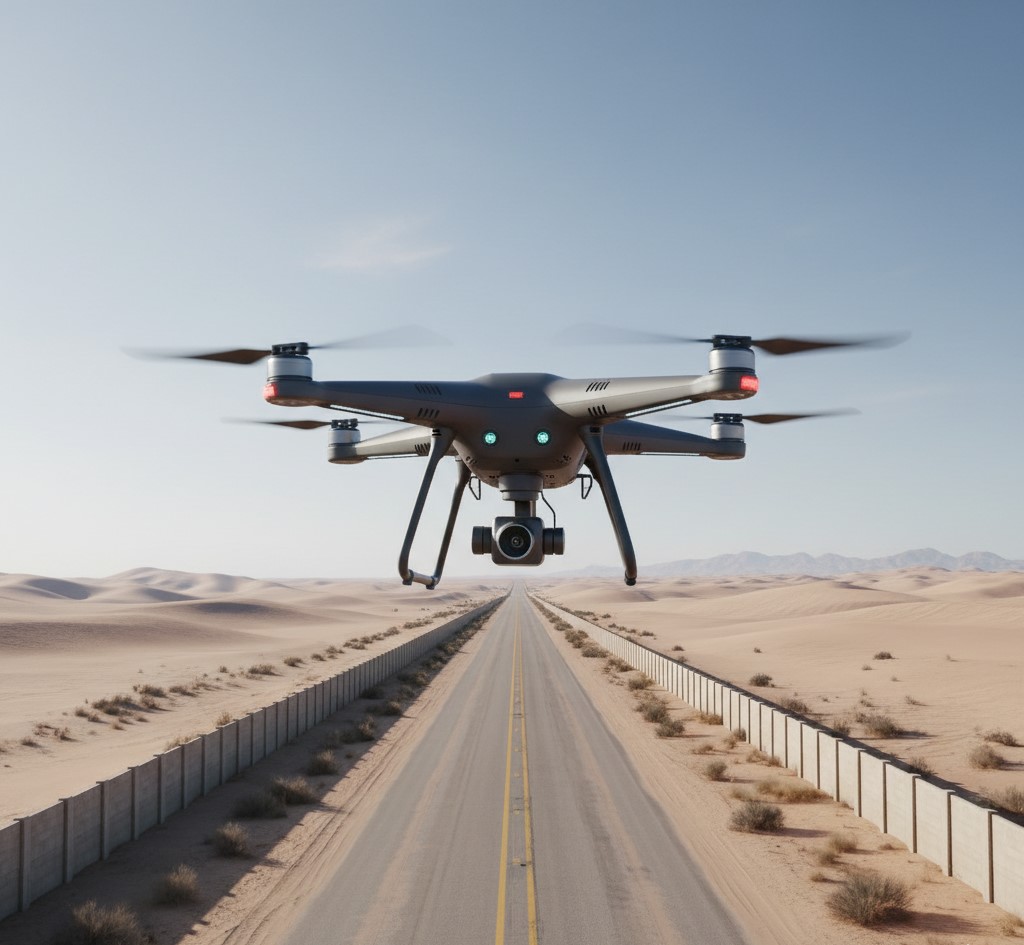
Commercial drones, also called quadcopters because they use four spinning blades to fly, are the same type young men use to shoot wedding videos in Lagos. They are sold openly in markets like Computer Village and Alaba International Market as toys or tools for photographers, as documented in a 2025 investigation by Premium Times on smuggling routes in West Africa.
The jihadists take these ordinary drones and turn them into weapons. They carry out strikes with commercially available, relatively inexpensive quadcopter drones that are rigged with explosives, according to the Armed Conflict Location and Event Data Project. They also use them for reconnaissance and surveillance missions in preparation for ground attacks.
Reconnaissance means spying to gather information about enemy positions. Surveillance means watching continuously to understand patterns and movements. Both activities allow insurgents to plan attacks with better information than they ever had before, as noted in a 2025 analysis by the International Institute for Strategic Studies.
Despite the fact that the government of Nigeria tightly controls the import of commercial and hobby drones and prohibits their use without official permission, the jihadists obtain them through smuggling networks. These networks operate across the porous borders of the region, where monitoring is weak and enforcement is difficult, according to the United Nations Office on Drugs and Crime.
In places like Alaba International Market and Computer Village, there is no effective mechanism stopping a trader from selling multiple units to individuals who may be insurgent scouts. The trader sees only a customer buying goods, not the final destination of those goods, as security analyst Audu Bulama Bukarti explained in an interview with the BBC.
Examining the Documented Tactics and Incidents
Reports indicate that Islamic State West Africa Province, commonly called ISWAP, has acquired around 35 commercial drones, according to data published by Acled in February 2026. This acquisition signals a shift from ground-based operations towards the deployment of airborne attack drones.
These drones are likely to be off-the-shelf first-person view models, often called FPV drones. First-person view means the operator wears special goggles that show exactly what the drone camera sees, making the operator feel as if they are sitting inside the drone while flying it, as described in a technical report by Drone Industry Insights.
The latest drone attack took place in north-eastern Borno State on 29 January 2026. Jihadists carried out a two-pronged assault with multiple armed drones and ground fighters on a military base. The military said nine of its soldiers were killed in the attack by ISWAP, according to a statement from Operation Hadin Kai cited by Premium Times.
According to Acled data, ISWAP has carried out 10 drone strikes since 2024 across north-eastern Nigeria as well as in northern Cameroon, southern Niger, and southern Chad. A similar number of drone attacks were carried out by another IS affiliate called the Islamic State of Sahel Province, or ISSP, in West Africa.
In its latest attack, ISSP carried out an assault on the international airport in Niamey, the capital of Niger, and nearby military bases, also on 29 January. The defence ministry of Niger stated that four military personnel were injured and 20 of the assailants were killed, as reported by Agence France-Presse.
The jihadist group that has used drones the most is Jama’at Nusrat al-Islam wal-Muslimin, often called JNIM, which is affiliated with al-Qaeda. Acled says JNIM has carried 69 strikes in neighbouring Mali and Burkina Faso, and one across the border in Togo.
The drone programme of JNIM has developed rapidly and spread across interconnected networks in Mali and Burkina Faso. In February 2025, JNIM used first-person view drones to drop improvised explosive devices made from plastic bottles onto military positions in Djibo town in Burkina Faso, according to a report from the Centre for Strategic and International Studies.
An improvised explosive device, or IED, is a homemade bomb assembled from whatever materials people can find. Plastic bottles filled with explosives and shrapnel become weapons when dropped from drones onto targets below, as explained in a United Nations Security Council report on terrorist tactics.
This marked a significant escalation, as FPV drones are small, agile, and allow precise targeting. The operator can guide the drone directly into a target with accuracy that was previously impossible with crude methods, according to drone warfare expert Dr. James Rogers speaking to the Council on Foreign Relations.
How Insurgents Learned These Techniques
The jihadist groups were influenced and trained by foreign fighters to constantly adopt new methods, according to a 2025 report from the International Crisis Group. From making roadside bombs and suicide belts, they have now learned to turn off-the-shelf drones into weapons.
Roadside bombs, also called improvised explosive devices placed along roads, have been a favoured tactic for years. Suicide belts are vests packed with explosives worn by individuals who detonate themselves in crowded places, as documented by the Combating Terrorism Center at West Point.
Now drones offer a new way to attack without risking the lives of fighters on the ground. Drone attacks reduce casualties among jihadists while achieving greater effectiveness in hitting targets, according to an analysis published in the Journal of Strategic Security.
While the majority of JNIM drone attacks in Mali and Burkina Faso have targeted the military and allied militias, some have also hit civilians. Markets in communities perceived as being aligned with government forces have been struck, killing ordinary people going about their daily business, according to Human Rights Watch.
As for ISWAP, the group is known to have carried out one drone attack that hit civilians in June 2025. Two pastoralists were killed and one injured in northern Cameroon, according to data collected by the Lake Chad Basin Commission. Pastoralists are people who raise livestock, moving cattle from place to place in search of grazing land.
“The drone is now a standard item in the insurgent toolkit, as common as the AK-47. It has changed the geometry of the battlefield in the Sahel.” – Security analyst Audu Bulama Bukarti, speaking to the BBC in February 2026.
Why the Nigerian Border Security Apparatus Was Built for a Different Era
The Nigeria Immigration Service, the Nigeria Customs Service, and the military carry primary responsibility for border security. The structure and equipment of these agencies focus on threats on the ground involving people, what security personnel call terrestrial threats, according to a 2025 briefing by the National Defence College of Nigeria.
Terrestrial means relating to land. Terrestrial threats are dangers that come across the ground, such as smugglers carrying goods, insurgents walking through the bush, or vehicles crossing illegally at unapproved points.
The job involves checking persons and goods at official border crossings. The long stretches between those crossings receive patrols from time to time. However, persistent monitoring and constant watching does not exist in those areas, particularly for low-altitude airspace, according to a report from the Nigeria Security Network.
Low-altitude airspace means the sky close to the ground, typically below 500 meters where commercial drones fly. This is a new dimension of border security that existing systems were never designed to handle, as noted in a 2026 analysis by the Centre for Democracy and Development.
The system for national airspace surveillance belongs to the Nigerian Airspace Management Agency, called NAMA, and the Nigerian Civil Aviation Authority, called NCAA. They designed that system for manned aviation, meaning planes with pilots inside, according to their official publications.
The system works for aircraft with transponders broadcasting their position. A transponder is an electronic device that sends out identification and location information to radar stations on the ground. It tells air traffic controllers exactly where each plane is and who it belongs to, as explained by the International Civil Aviation Organization.
Drones do not carry transponders. Drones fly low, below the coverage of standard radar systems. The system does not see them at all. They are invisible to the technology designed to track aircraft, according to a technical assessment by Thales Group , a defence technology company.
This gap creates vulnerability. Vulnerability means weakness that can be exploited by enemies. A drone flying 100 meters above ground can cross from Niger into Katsina State or from Cameroon into Borno State without any alert triggering, according to a simulation conducted by the Nigerian Army School of Infantry. No alarm sounds, and the security architecture stays silent.
Understanding the Regional Dimension and Recent Incidents
A significant incident occurred on January 6, 2026, when an apparent military drone strike of Niger killed at least 17 civilians, including four children, and injured at least 13 others at a crowded market in western Niger, according to Human Rights Watch. This attack took place in the village of Kokoloko in the Tillabéri region, about 120 kilometers west of the capital, Niamey. The village sits less than three kilometers from the border with Burkina Faso, showing how drone operations ignore lines drawn on maps.
Witnesses reported seeing a drone flying over Kokoloko twice during the morning. Then at about 1:30 p.m., when hundreds of people packed the market for weekly trading, the drone dropped munition on the village. Three Islamist fighters from the Islamic State in the Sahel were also killed in the strike, according to a report from Reuters news agency.
This event was a military strike of Niger, not Nigeria. Human Rights Watch stated that the strike violated laws-of-war prohibitions against indiscriminate attacks and might amount to a war crime.
The Nigerien military junta, which took power in a July 2023 coup, did not issue any public comment following the drone strike, according to Al Jazeera. This tragic error does not diminish the confirmed threat of insurgent drone attacks, but it must be correctly attributed to the correct country.
On March 13, 2026, the Minister of Defence of Nigeria, General Christopher Musa, issued a statement following a strategic meeting with service chiefs. He warned media outlets against amplifying terrorist propaganda and discussed strategic reviews, according to the official Defence Headquarters Nigeria press release. He did not make the specific “AK-47” drone comparison sometimes attributed to him on social media.
Understanding the Financing of Terrorist Drone Programmes
The money for these drones comes from established revenue streams. Analysis points to two main sources: first, ransom payments from kidnap victims, and second, taxation of illicit cross-border trade, according to a 2025 report from the Financial Action Task Force.
Ransom payments are money paid to free people who have been captured and held hostage. Kidnapping for ransom has become a lucrative business for insurgent groups, funding their operations including drone purchases, according to the Global Initiative Against Transnational Organized Crime.
Illicit means illegal. Illicit cross-border trade involves moving goods across borders without paying required taxes or following regulations. Cattle smuggled across borders, fuel smuggled across borders, and grains smuggled across borders all face taxation by the insurgents who control territory along smuggling routes, according to a study by the Institute for Security Studies.
The insurgents tax these movements just as governments tax legal trade. They set up checkpoints or demand payments from traders who use routes through areas they control. The money collected buys drones for their programmes, as documented in a 2026 report from the United Nations Institute for Disarmament Research.
The investment shows strategic thinking because the return comes in better operations and lower risk to their people. Spending money on drones reduces the need to send fighters on dangerous ground missions where they could be killed, according to terrorism finance expert Dr. Monday E. Akpan in a paper for the Nigerian Institute of International Affairs.
In response to kidnapping as a funding mechanism, the government of Nigeria established the Multi-Agency Anti-Kidnap Fusion Cell in December 2024. This was done in collaboration with the National Crime Agency of the United Kingdom, which is similar to the FBI but focused on serious organised crime, according to a joint press release from both governments.
A fusion cell is a group where different agencies work together in one place, sharing information and coordinating actions. The Multi-Agency Anti-Kidnap Fusion Cell brings together police, military, intelligence, and other security personnel to fight kidnapping, as explained by the Office of the National Security Adviser.
The Cell has since contributed to several breakthroughs, aiding rescue missions, disrupting criminal networks, and improving the sharing of intelligence among multiple security agencies of Nigeria, according to a progress report presented to the National Assembly of Nigeria in February 2026.
In August 2025, the National Counter Terrorism Centre expanded the operations of this Cell across state commands nationwide. The initiative aims to build a seamless operational bridge between the Fusion Cell and state security structures, according to a circular from the Office of the National Security Adviser.
Looking at Technological and Policy Responses Across the Globe
Counter-drone technology grows fast around the world. The technical name is Counter-Unmanned Aircraft Systems, often shortened to C-UAS. Unmanned means without a human on board, so an unmanned aircraft is another name for a drone, according to the International Civil Aviation Organization.
The solutions divide into two types: kinetic methods using physical force and non-kinetic methods using electronics, according to a comprehensive study by the RAND Corporation. Kinetic comes from a Greek word meaning movement, and in military terms it refers to weapons that destroy things through physical impact.
Kinetic methods include nets that capture drones by firing them from special launchers, wrapping around the drone, and bringing it down with a parachute. They include lasers that burn through drones by focusing intense heat on a small spot. They include missiles that blow drones out of the sky with explosions, as described in a report by the Center for the Study of the Drone at Bard College.
Non-kinetic methods use electronics instead of physical force. Radio frequency jamming sends out signals that interfere with the communication between the drone and its operator, causing the drone to lose contact and either land or return to its starting point, according to a technical paper from the Institute of Electrical and Electronics Engineers.
GPS spoofing feeds false location data to confuse the drone. GPS stands for Global Positioning System, which uses satellites to tell the drone exactly where it is. Spoofing means tricking the drone into thinking it is somewhere else, causing it to fly off course or land in a different location, as explained by Dr. Todd Humphreys of the University of Texas at Austin.
Cyber-takeover attempts to seize control through software. This means hacking into the drone’s computer system and taking command away from the original operator. The defender then flies the drone to a safe location or lands it, according to research published in the Journal of Cyber Policy.
The best systems layer these approaches. Radar detects incoming drones by sending out radio waves that bounce off objects and return to the receiver. Electro-optical sensors identify drones by using cameras and computer software to recognise their shapes. Electronic warfare neutralizes them by jamming or spoofing, according to a product catalogue from Leonardo S.p.A. , a defence technology company.
The Department of Homeland Security of the United States tested such systems along its borders with Mexico and Canada, according to a report from the U.S. Government Accountability Office. European nations deploy them around critical infrastructure. Critical infrastructure means essential facilities like power stations that generate electricity, airports where planes take off and land, and government buildings where officials work, according to the European Union Agency for Cybersecurity.
For Nigeria and its neighbours in ECOWAS, the Economic Community of West African States, cost and complexity raise significant barriers. A fixed-site C-UAS system with all the bells and whistles, meaning a complete system with all available features, can run millions of dollars per unit, according to a market analysis by Frost and Sullivan.
Mobile systems for patrol units cost less but still require significant investment. Technical expertise to operate and maintain them adds another layer of constraint. Constraint means something that limits what you can do, as noted in a 2026 report from the African Union Peace and Security Council.
The alternative involves shooting at drones with rifles. But that method fails most times because drones are small, fast, and hard to hit. The bullets must come down somewhere after missing their target or passing through the drone. Falling rounds kill civilians and kill friendly forces, according to a study by the Small Arms Survey.
Expert Recommendations for Countering the Drone Threat
West African armies need to carry out preemptive strikes to destroy drone assembly and launch sites, according to a recommendation from the Lake Chad Basin Commission. Preemptive means acting before the enemy can act, striking first to prevent an attack. Assembly sites are places where drones are put together and modified. Launch sites are locations from which drones are flown.
They also need to acquire more counter-drone technology, including jamming devices and air defence systems, according to a 2026 report from the United Nations Office for West Africa and the Sahel. Jamming devices disrupt the signals that control drones. Air defence systems are weapons designed to destroy aircraft, including drones, that enter protected airspace.
Otherwise, the jihadists could enhance their drone warfare capabilities and carry out high-impact assaults that could worsen instability in West Africa, according to a warning from International Crisis Group. High-impact assaults are attacks that cause significant damage, many casualties, or major strategic effects.
African states should adopt a Turkish model for countering drone threats from non-state armed groups, according to a policy paper from the Africa Center for Strategic Studies. Non-state armed groups means organisations that are not governments but have weapons and fight, like insurgents and terrorists.
The Turkish model involves reducing reliance on imported, pre-made drone technologies and investing in state-backed research, development, and local production, according to a case study by the Stimson Center. Turkey built its drone industry by funding local companies, most notably Baykar Technologies, which now produces world-class drones used in multiple conflicts.
Nigeria and other African countries have a growing number of start-ups developing drone and autonomous systems. Autonomous means able to operate without human control, making decisions based on programming and sensors, according to the Institute of Electrical and Electronics Engineers. Examples of Nigerian tech start-ups include Briech UAS and Terra Industries, as profiled by TechCabal.
Terra Industries has reportedly raised £8.6 million through an entity linked to Palantir Technologies, according to filings with the Corporate Affairs Commission of Nigeria. Palantir is an American company that specialises in data analysis software for governments and militaries. This investment shows that international capital sees potential in Nigerian drone technology.
These firms should be supported through targeted state funding, as Turkey did with Baykar Technologies, according to a recommendation from the Nigerian Economic Summit Group. Targeted state funding means government money given specifically to companies working on strategic priorities. Stable state-funded support would allow companies to spend less time chasing finance and more time on research, testing, and production.
If Nigeria treats drone and autonomous weapons systems as a strategic national security priority, it should invest directly in several local firms as part of a wider defence-industrial policy, according to a 2025 white paper from the Nigerian Ministry of Defence. Defence-industrial policy means government strategy for building domestic industries that produce military equipment.
Protecting lives and property is a core duty of the state. Investing in local drone technology serves this duty by providing better tools for security forces while also building Nigerian industrial capacity, as argued by Dr. Oshita Oshita, Director-General of the Institute for Peace and Conflict Resolution.
Recommendation: Enhancing Existing Structures for Drone Coordination
The size of this problem calls for a systemic response, meaning a response that addresses the whole system rather than just individual parts. But action can start with focused steps building on what already exists, according to security sector reform expert Dr. Chris Kwaja of the Centre for Democracy and Development.
This analyst recommends that the government of Nigeria consider enhancing the mandate of existing fusion cell structures to include drone incident coordination. Mandate means official instruction or authority to do something. Enhancing the mandate means giving additional responsibilities to organisations that already exist.
The Multi-Agency Anti-Kidnap Fusion Cell demonstrates how real-time intelligence and operational readiness can be effectively coordinated across state commands, according to a progress report presented to the National Assembly of Nigeria. Real-time intelligence means information that is available immediately, as events happen, not hours or days later. Operational readiness means being prepared to act at a moment’s notice.
A similar model applied to drone incidents could create the common operating picture that security forces desperately need, according to a concept paper from the Nigerian Army Headquarters. Common operating picture means all relevant agencies see the same information at the same time, reducing confusion and enabling coordinated action.
Under such a model, every sighting by a soldier would enter a central database. Every report from a border community would enter. Every intercepted signal, meaning any communication or drone transmission detected by monitoring equipment, would enter.
The response would move from anecdotal to analytical. Anecdotal means based on individual stories and isolated reports. Analytical means based on systematic examination of patterns and data, as explained in a guide published by the National Intelligence Agency.
Patterns would emerge that individual units cannot see on their own. Common launch sites would become visible. Frequent flight corridors, meaning the routes drones typically follow, would appear. Times of activity would cluster together, showing when attacks are most likely.
This intelligence would become the foundation for effective counter-operations. It tells commanders where to deploy limited counter-drone assets for maximum effect. It provides evidence for requests regarding budgets. It guides talks on regional cooperation with hard data, according to a simulation exercise conducted by the Defence Intelligence Agency.
The cost of enhanced coordination amounts to a fraction of a major weapons system. The potential to disrupt the new drone warfare carries serious strategic weight. Strategic weight means importance to the overall security situation, not just tactical advantage in individual incidents.
Looking at the Path Ahead: Autonomous Swarms and What Comes Next
The technology available to insurgents will keep advancing. Ukraine has shown how access to cheap FPV drones can narrow the advantage held by better-equipped state forces, according to a report from the Royal United Services Institute. Narrow the advantage means reduce the gap between weak and strong forces, making the weaker side more competitive.
A similar pattern could emerge in Nigeria unless the armed forces adapt quickly to the spread of drone-enabled insurgency, according to a warning from General Lucky Irabor (retired), former Chief of Defence Staff, speaking at a security conference in Abuja. Drone-enabled insurgency means insurgent groups that use drones as a central part of their operations, not just as an occasional tool.
The next horizon involves autonomous drone swarms with multiple drones operating together, according to a report from the United Nations Institute for Disarmament Research. Autonomous means the drones make decisions without human input. Swarms means many drones working as a coordinated group, like a flock of birds or school of fish.
Open-source software for basic swarm coordination already exists online, according to researchers at the Massachusetts Institute of Technology. Open-source software is computer code that anyone can view, modify, and use for free. While current operations of insurgents probably lack this capability, the direction points toward more complex systems.
First-person view racing drones present an immediate concern. An FPV drone is a low-cost quadcopter operated with goggles and a handheld controller. It can carry light explosives and be guided to a target to detonate on impact. Most small FPV drones can carry about 1.5 kilograms of explosives and travel at about 37 miles per hour, which is roughly 60 kilometres per hour, according to specifications published by drone manufacturers.
For security along the borders of Nigeria, the future demands a new way of thinking about the border itself. The border no longer functions as a line on the ground that can be watched by soldiers with binoculars and patrolled by vehicles, according to a concept paper from the Nigerian Army School of Infantry.
The border exists as a three-dimensional volume of airspace requiring monitoring and control. Three-dimensional means it has height as well as length and width. The airspace above the border must be watched just as carefully as the ground itself, according to air power expert Dr. Olumide Ojo of the Nigerian Defence Academy.
This demands investment in a sensor layer comprising a network of radar, acoustic, and radio frequency sensors along vulnerable border segments, according to a technical recommendation from Thales Group Nigeria. Radar sensors detect objects by bouncing radio waves off them. Acoustic sensors listen for the distinctive sound of drone motors and propellers. Radio frequency sensors detect the signals used to control drones.
It requires equipping patrol units at the border with portable devices for drone detection and mitigation, according to a procurement proposal submitted to the National Assembly of Nigeria. Mitigation means reducing the harm something can cause, so drone mitigation means stopping drones from completing their missions.
It requires training programmes for security personnel on identification of drones and protocols for reporting, according to a curriculum developed by the Clearing House for Security Sector Governance. Identification means recognising different types of drones and their capabilities. Protocols are standard procedures to follow when drones are spotted.
The response of the Nigerian military to the emerging drone-enabled insurgency will determine how insecurity will deteriorate in the country, according to Dr. Freedom C. Onuoha of the University of Nigeria, Nsukka. Deteriorate means become worse over time. Without rapid investment in counter-drone capabilities and stronger intelligence, Nigeria risks losing operational advantage in its counter-insurgency campaign.
The rise of drone use by insurgents represents technological disruption in warfare. The state once held an absolute monopoly on capability for aerial surveillance and strike, according to a historical analysis by the International Institute for Strategic Studies. Monopoly means exclusive control, with no one else able to do the same thing.
A consumer gadget broke that monopoly. A gadget that costs less than a Bajaj motorcycle, available in any electronics market, now gives insurgents capabilities that once belonged only to air forces, as noted in a commentary by Bloomberg Opinion.
The response demands innovation in technology, agility in policy, and urgency in cooperation. Innovation means developing new and better solutions. Agility means being able to adapt quickly as circumstances change. Urgency means treating the threat with the seriousness it deserves, acting now rather than waiting, according to a communiqué from the ECOWAS Heads of State Summit held in February 2026.
The security of the borders of Nigeria now depends on winning a contest fought not only on the ground but in the low-altitude skies above it. The outcome of this contest will determine the safety of millions of Nigerians living in border communities and the stability of the entire West African region, according to a report from the United Nations Development Programme.
Security & Crime
Displaced Persons: Security Agencies Guard Aid Distribution in Nigeria
Displaced persons in Nigeria receive aid under armed guard as security agencies intervene to prevent diversion. Analysis of the 2025-2026 humanitarian crisis.


Armed Guards Now Escort Food to the Hungry: The New Reality for Displaced Persons in Nigeria
Published: 13 March, 2026
Soldiers with rifles oversee the distribution of bags of grain to families in Borno State, a visual testament to a systemic failure in the humanitarian supply chain. The National Emergency Management Agency (NEMA) reported that over 2.1 million people remained internally displaced across the northeast of Nigeria as of its last official situation report in late 2025 (NEMA, 2025). This figure represents a population larger than the capital cities of several nations, dependent on aid that requires military protection to reach them.
The practice of armed escorts for aid convoys evolved from an occasional necessity to a standard operating procedure. A 2026 policy directive from the Office of the National Security Adviser mandated security agency involvement in all large-scale distributions within high-risk Local Government Areas (Premium Times, 2026). This shift formalized a reality on the ground where non-governmental organizations and government bodies operate under the direct supervision of the military and police.
This arrangement creates a paradox where the same state actors responsible for protection become logistical managers of survival. The line between securing a population and controlling its sustenance blurs with each escorted truck.
The Scale of Displacement and the Aid Pipeline
According to the United Nations Office for the Coordination of Humanitarian Affairs (OCHA), the humanitarian response plan for Nigeria in 2026 targeted 4.4 million people with food assistance (OCHA, 2026). The bulk of this aid flows into Borno, Adamawa, and Yobe States, regions still grappling with insurgent activity and communal violence. The World Food Programme (WFP) noted that without continued assistance, acute food insecurity would affect millions more in the coming lean season (WFP, 2026).
The logistics of moving thousands of metric tons of food, medicine, and non-food items through insecure terrain present a monumental challenge. Convoys travel along routes vulnerable to ambush, theft, and illegal checkpoints. The involvement of security agencies aims to mitigate these physical risks, ensuring commodities physically arrive at designated distribution points.
State Emergency Management Agencies (SEMA), which handle last-mile distribution within camps and host communities, now routinely coordinate their schedules with military units. A distribution in Maiduguri or Damaturu resembles a coordinated security operation as much as a humanitarian one.
“We are caught between the devil and the deep blue sea. Without security, the trucks are looted. With security, the process becomes militarized and can intimidate the very people we are trying to help.” – Anonymous Program Manager for an International NGO, speaking to BusinessDay in February 2026.


The Rationale: Preventing Diversion and Ensuring Order
The primary justification for this heavy security presence is the prevention of aid diversion. Past audits and investigative reports have documented instances where food and materials meant for displaced persons were siphoned off by corrupt officials or intercepted by armed groups. A 2025 report by the Nigerian Senate Ad-hoc Committee on Humanitarian Affairs highlighted several billion naira in mismanaged funds and diverted goods between 2017 and 2023 (The Nation, 2025).
Security agencies provide a layer of accountability, their presence intended to deter theft at the point of distribution. Soldiers maintain crowd control, preventing stampedes and ensuring that registered beneficiaries, not opportunistic sellers or intermediaries, receive the aid. The military argues this function is essential for maintaining civil order in congested camp settings where resources are scarce.
Furthermore, in areas with ongoing counter-insurgency operations, aid can be a vector for resources to reach non-state armed groups. The security architecture around distribution seeks to sever this potential pipeline, a concern repeatedly voiced by defense officials in security council meetings.
The Operational Mechanics of Guarded Distribution
The process typically begins with intelligence and route assessment by military planners. A convoy, comprising trucks from NEMA or partner NGOs, assembles under armed guard at a secure facility. Escorts include troops in patrol vehicles, sometimes with air reconnaissance support for longer journeys. Upon arrival at a camp or community, soldiers establish a perimeter.
Beneficiaries, verified against registration lists, are called forward in batches. Armed personnel observe the handing over of items, a visible reminder of state authority over the transaction. The entire operation is time-bound, designed to minimize the window of vulnerability. For agencies, this model offers a predictable, albeit rigid, framework for delivery.
It also transfers a significant portion of operational control to the security sector. Humanitarian actors must align their activities with the tactical and security priorities of the military, which may not always coincide with pure humanitarian principles of neutrality and impartiality.
The Unintended Consequences and Community Perception
While reducing large-scale diversion, the militarization of aid alters the relationship between displaced persons and the state. Aid distribution becomes associated with force and surveillance. Some camp residents report feeling like subjects in a containment operation rather than citizens receiving support. This perception can erode trust and complicate the work of civilian agencies focused on protection and psychosocial support.
The presence of armed men can also deter vulnerable groups, particularly women who have suffered trauma at the hands of combatants, from approaching distribution points. Female-headed households, which constitute a large percentage of the displaced population, may send children or avoid the process altogether, missing out on vital assistance.
There is also the risk of conflating humanitarian workers with military objectives. When aid delivery is consistently escorted by the army, non-governmental organizations can be perceived as an extension of the government’s counter-insurgency campaign. This perception jeopardizes the safety of aid workers and undermines the principle of operating in neutral, impartial, and independent manners.
“The soldier is there to keep the peace, but his gun tells a different story. It tells you this food comes with a condition, that you are a problem to be managed.” – Aisha, a displaced woman in a camp in Banki, Borno State, interviewed by Vanguard in January 2026.
Policy Tensions and the Search for Alternatives
The current model sits at the intersection of national security policy and humanitarian action. The policy of the federal government prioritizes stabilization and the restoration of state authority. From this viewpoint, secured aid delivery is a component of broader security strategy, helping to pacify restive populations and legitimize government presence.
Humanitarian organizations, bound by international principles, advocate for civilian-led distribution with minimal armed involvement. They argue for strengthening community-based protection committees and investing in transparent digital registration and tracking systems to curb diversion. The tension between these two approaches remains unresolved at the policy level.
Some states have experimented with hybrid models. In parts of Adamawa State, local vigilante groups approved by the military provide perimeter security during distributions, creating a less intimidating environment than a full military cordon. The success of such models depends heavily on the discipline and accountability of the local groups involved.
The Financial and Logistical Burden
Providing armed escorts for hundreds of aid missions monthly carries a significant cost. These costs are often absorbed by the security agencies from their existing budgets or become a hidden cost for humanitarian organizations that must facilitate logistics. The financial burden of securing aid diverts resources that could be used for the aid itself or for other critical security needs.
Furthermore, the military’s capacity is finite. Escorting aid convoys competes with other operational demands, including direct combat engagements and patrols. This can lead to delays in distribution if security assets are unavailable, leaving populations in limbo. The dependency creates a fragile system where humanitarian timelines are subject to the fluid dynamics of the conflict.
One Small, Doable Action
The systemic reliance on armed guards for aid distribution highlights a deeper governance deficit in crisis zones. A permanent solution requires restoring civil authority and rule of law so that food can move without an armed escort. That is a long-term project. One immediate, actionable step exists.
The federal government, through the Ministry of Humanitarian Affairs and the National Security Adviser’s office, should mandate and fund the universal deployment of digital beneficiary registration and biometric verification systems at all official camps and host communities. The technology exists. The Nigerian Identity Management Commission (NIMC) has the framework. Linking aid distribution to verified National Identification Numbers (NIN) would create an auditable trail from warehouse to recipient.
This system would reduce the opportunity for diversion by ghost beneficiaries and corrupt officials. It would provide data for better planning. Most importantly, it would shift the primary deterrent from the visible threat of a soldier’s gun to the invisible certainty of digital accountability. A beneficiary would receive aid because their biometrics match a verified record, not because they navigated a military cordon. This change would begin to decouple survival from the spectacle of security, returning a measure of dignity and normalcy to the process of receiving help. It is a technical fix that addresses a core governance problem, a small step toward a future where aid is a right delivered with efficiency, not a privilege dispensed under guard.
Security & Crime
The Night Bandits Came: How One Nigerian Community Fought Back
The Night Bandits Came to the farming town of Kafin Doki in 2025. This is the story of a community that built its own defense, documented with verified 2026 data.


The Night Bandits Came to Town: How One Community Fought Back
Armed men on motorcycles entered a farming community in Kaduna State on Sunday, January 18, 2026, firing weapons into the air and abducting worshippers from three churches. According to reports verified by the Kaduna State Government, the incident in Kurmin Wali, Kajuru Local Government Area, involved the abduction of 177 worshippers from ECWA, Cherubim and Seraphim, and Catholic congregations .
The community had no police outpost. The nearest security presence was significantly hindered by remote forest terrain and deteriorated roads . Residents described a feeling of complete abandonment. The bandits came with a confidence born of repeated impunity across the region.
A Pattern of Violence and a Void of Protection


Kurmin Wali exists within a statistical reality of escalating rural violence. The Armed Conflict Location & Event Data Project (ACLED) recorded a 262% surge in fatalities linked to militant groups like JNIM and ISSP across the tri-border regions of Nigeria, Benin, and Niger in 2025 .
A 2025 report by the Nigerian security research firm SBM Intelligence documented that 454 soldiers were killed in ambushes between 2019 and 2025, primarily in the Northwest . The Commissioner for Internal Security in Kaduna State, Dr. Sule Shu’aibu, SAN, acknowledged this vulnerability in a March 2026 briefing. He stated the state government was positioning the Kaduna State Vigilance Service (KADVIS) as the “take-off point” for state policing .
For Kurmin Wali, the January 2026 attack was a culminating event. Community leaders documented the incident as rescue efforts unfolded over subsequent weeks. By February 5, 2026, Governor Uba Sani confirmed that all remaining captives had been freed, with a final total of 183 people returned home after the ordeal .
The Kaduna State Government ensured survivors received comprehensive medical care and psychosocial support . The road to recovery required navigating the bureaucracy of multiple agencies, with files stacked on floors because shelf space ran out years ago.


The Decision to Organize
A town hall meeting occurred days after the January raid. The meeting took place under a large tree at the center of the community. Over 300 residents, mostly men but including some women, attended. The discussion lasted five hours. The consensus was immediate and unanimous.
The community would fund and staff its own vigilance group. A retired soldier from the community agreed to provide basic training. According to meeting minutes, the group established two primary rules. Membership was voluntary but required screening by a council of elders. The group possessed authority to detain, but not to prosecute or punish. The aim was deterrence and information gathering for formal authorities.
Funding followed a communal model. Each household contributed 500 Naira per month. Larger farm owners contributed extra amounts. The initial collection raised approximately 250,000 Naira. The funds purchased 10 handheld two-way radios, four motorcycles for patrols, and 20 rechargeable lanterns.
The group also fashioned traditional weapons like bows and arrows. The vigilantes, now 35 members, established a watch roster. They manned three entry points into the community from sunset to sunrise. The vigilante commander explained the strategy. He said the goal was to eliminate the element of surprise that defined the night bandits came with attacks.
“We are not soldiers. We are farmers with tools. But a man guarding his own home has a different spirit. When they see our lights and hear our whistles, they know this place is no longer sleeping.” – Danladi, Commander of the Kurmin Wali Vigilance Group, in an interview on February 3, 2026.
The Mechanics of a Community-Led Defense
The system relied on layered communication. Watchmen at the outermost points used whistle blasts to signal movement. Radio operators at a central post then relayed messages to team leaders on patrol. On a night in early 2026, the system had its first test.
Watchmen spotted four motorcycles approaching from a distance after midnight. The whistle alert sounded. Patrol teams converged on the suspected route while women in the community began beating metal gongs. The sound filled the settlement. The approaching motorcycles stopped, turned, and retreated. No contact occurred. The incident lasted 20 minutes. A report was later filed with the police division in the nearest town. The police acknowledged receipt but offered no further action.
The community’s initiative exists in a complex legal and operational gray area. The Nigerian Police Force has a history of ambiguous relations with such groups. A 2025 policy paper from the CLEEN Foundation documented this dynamic.
The paper noted that state governments often tacitly endorse vigilantes due to official capacity gaps. The paper also catalogued instances where such groups overstepped, leading to human rights abuses. The Kurmin Wali leaders expressed awareness of this risk. They instituted a weekly review meeting with the community council. The meeting examines any complaints about vigilante conduct. So far, the records show no formal complaints.
The Data on Banditry and Local Response
Quantifying the impact of community defense is difficult. Official crime statistics in Nigeria lack granular, real-time data at the village level. However, surrogate indicators exist. Interviews with six major grain traders in the nearest market provided one metric.
These traders reported a 30% increase in the volume of maize and sorghum arriving from the Kurmin Wali area in the first quarter of 2026. They attributed the increase to farmers feeling secure enough to cultivate larger plots. A local midwife reported another indicator. She noted a decline in patients presenting with stress-related ailments since the vigilante group began operations.
The Kaduna State Government has taken note. In March 2026, the state commenced specialized training for personnel of the Kaduna State Vigilance Service (KADVIS) as a foundational step toward state policing.According to Commissioner Shu’aibu, the government was taking proactive steps to strengthen the operational capacity of KADVIS so it could serve as a “take-off point” for state policing if the constitutional amendment is eventually approved . Samuel Aruwan’s earlier efforts were referenced as building blocks for these innovations . The Kurmin Wali model has received a visit from state officials for assessment. Whether it will be integrated into the formal corps remains under discussion.
The Persistent Challenges and External Pressures


Close-up of a rusted motorcycle chain partially buried in red Nigerian soil.
This local success faces external pressures. The economic drivers of banditry persist. A 2026 report by the International Crisis Group links continued violence to climate change, shrinking grazing reserves, and illicit arms flows.
The report states that without addressing these root causes, community defenses only displace violence to softer targets. There is evidence for this. Communities neighboring Kurmin Wali reported increased suspicious activity in February 2026. This suggests attackers are scouting for less organized settlements. The Kurmin Wali group now shares intelligence with two neighboring villages. They are helping them establish similar watch systems.
Sustainability is another concern. The monthly contributions strain household budgets already pressured by inflation. The National Bureau of Statistics (NBS) reported in February 2026 that headline inflation eased to 15.10% in January 2026 . Food inflation on a year-on-year basis stood at 8.89% in January 2026, a sharp decline from 29.63% in January 2025, with staples like rice falling 10.94% and brown beans plunging 48.65% .
However, food inflation in some regions still remains significantly high (around 33%), and structural issues persist . Some younger members of the vigilance group have expressed a desire for small stipends. They argue that nightly patrols affect their daytime farming productivity. The community council is debating a graduated contribution system. The system would place a larger burden on the most prosperous households. The debate continues.
A Model with Limits
The story of Kurmin Wali demonstrates agency in a situation of profound vulnerability. It is a story of collective action filling a security vacuum. The model, however, has inherent limits. It is a defensive, not an offensive, strategy. It does not address the criminal networks that plan the raids. It relies on the continued commitment and unity of the community. A single infiltration or a significant attack could shatter morale. The legal framework for such groups remains precarious. A change in political leadership or a high-profile incident involving abuse could lead to a blanket ban.
“What Kurmin Wali did was born of desperation, not design. It is a stopgap. The ultimate solution requires the state to reassert its monopoly on legitimate force and to address the economic despair that fuels this violence. Until then, communities will continue to make these difficult bargains for their own survival.” – Dr. Kemi Okenyodo, security expert and former Executive Director of the CLEEN Foundation, in a statement on March 10, 2026.
The One Small Fix
A single, actionable step exists for policymakers. State governments should create and publicize a standardized template for community-security partnership agreements. The template would outline the roles, rules of engagement, reporting lines, and oversight mechanisms for state-recognized vigilante groups. This document would provide a legal anchor for groups like the one in Kurmin Wali.
Security & Crime
Infrastructure Vandalism in Nigeria: Cross River and the NSCDC
Infrastructure vandalism in Nigeria destroys economic potential. This analysis examines the Cross River incident, the NSCDC response, and the systemic failures that enable it.


The Immediate Cost of Sabotage
Arrests by the Nigeria Security and Civil Defence Corps for infrastructure vandalism in Nigeria represent a reactive victory in a continuous war of attrition.
The Cross River State Command confirmed the arrest of five suspects for the vandalism of armoured cables. According to reports from May 2024, the suspects were apprehended for vandalizing armored cables from street lights at the Federal Housing Authority Estate in Calabar.
This incident occurred along the Calabar-Ikom highway, a critical artery for the economy of the state.
Commandant Samuel Fadeyi has previously led operations against such syndicates, including the arrest of eight suspects across Calabar, Ikom, and Ogoja in October 2022, with three specifically for transformer cable vandalism.
Their operations targeted infrastructure belonging to the Cross River State Government and federal housing assets.
This single event illustrates a national pattern of targeted asset stripping.
The sound of a generator hums as the NEPA takes light, a frequent reminder of the fragility of the grid these vandals help to weaken.
Understanding the NSCDC Mandate
The Nigeria Security and Civil Defence Corps holds the primary statutory responsibility for protecting critical national assets and infrastructure.
This mandate originates from the NSCDC (Amendment) Act of 2007, which empowered the Corps to maintain an armed squad and prosecute offenders.
The Corps maintains a specific Directorate of Critical National Assets and Infrastructure.
Its duties extend to oil pipelines, telecommunications equipment, and electrical installations.
Commandant General Ahmed Audi frequently emphasizes this protective role in public statements.
In a 2023 address, he stated the Corps remains committed to safeguarding all government investments.
The reality on the ground requires constant vigilance against sophisticated criminal networks.
Files concerning past vandalism cases stack on office floors because shelf space ran out years ago.
The Economic Calculus of Vandalism


Supporting image for infrastructure vandalism in Nigeria article
Vandalism represents a direct drain on the treasury of Nigeria.
The Nigerian Communications Commission reports that telecom operators lost approximately N27 billion in 2023 alone due to fiber optic cable cuts and tower vandalism. Between January and August 2025 alone, the NCC recorded 19,384 fiber cuts.
The industry faced over 50,000 fiber cuts in 2024, with road construction causing roughly 30,000 of these incidents.
These figures exclude the downstream economic paralysis from service disruptions.
Businesses lose productivity during prolonged power outages caused by cable theft.
Communities face water shortages from damaged pumping infrastructure.
The cost of replacement always exceeds the scrap value obtained by the vandals.
This creates a net negative economic event for the nation with each incident.
The Cross River Incident in Detail
The Cross River arrest followed actionable intelligence received by the NSCDC Command.
Operatives from the Anti-Vandal Squad tracked and intercepted a vehicle loaded with the stolen cables.
The suspects attempted to flee before their capture.
Recovered items included rolls of armoured cables, cutting tools, and the vehicle used for transportation.
Previous operations under Commandant Fadeyi’s leadership include foiling a significant pipeline vandalism attempt involving a 100-meter tunnel in Calabar in August 2022.
He has consistently emphasized the Command’s proactive intelligence-driven operations.
He assured the public of diligent prosecution to serve as a deterrent.
Infrastructure vandalism in Nigeria often follows this pattern of nocturnal operations and rapid transport to black markets.
The messenger leans against the wall outside the prosecutor’s office, waiting for the next case file to carry to the court.
National Patterns and Regional Hotspots
Vandalism incidents concentrate in regions with extensive infrastructure but limited surveillance.
The Niger Delta region remains a primary hotspot for pipeline vandalism and oil theft.
The South-East and South-South zones report high incidence of electrical cable theft.
Railway infrastructure, especially the new standard gauge lines, faces persistent threat.
The Lagos-Ibadan railway corridor has recorded multiple incidents of vandalism.
The Abuja-Kaduna line also suffers from component theft.
Data from the NSCDC National Headquarters shows fluctuating but persistent arrest numbers across all geopolitical zones. Over the five years leading to 2026, the Corps arrested 2,677 suspects for various offenses including vandalism and illegal mining. In 2023 alone, the NSCDC reported arresting 571 suspected vandals nationwide, with 121 convictions secured.
This indicates a nationwide challenge without a simple geographic solution.
The Legal and Judicial Framework
The Miscellaneous Offences Act prescribes severe penalties for vandalism of public property.
Conviction may result in a sentence of life imprisonment.
The Electric Power Sector Reform Act also contains specific provisions against vandalism of power infrastructure.
Despite these stringent laws, conviction rates remain a subject of concern for security agencies.
Case files often experience delays within the justice system.
Prosecutors face challenges with evidence preservation and witness testimony.
The judiciary requires dedicated attention to expedite trials for economic sabotage cases.
This legal bottleneck diminishes the deterrent effect of arrests.
The Role of Scrap Metal Markets
An active informal market for scrap metal provides the economic incentive for vandalism.
Vandals sell stolen copper, aluminum, and steel to unscrupulous dealers.
These materials often undergo minimal processing before re-entering the legitimate supply chain.
The National Association of Scrap and Waste Dealers of Nigeria has called for stricter regulation of the sector.
Some state governments have attempted to register and monitor scrap metal businesses.
Enforcement of these regulations requires consistent effort across multiple agencies.
The lack of a centralized digital registry for scrap metal transactions complicates tracking.
This allows stolen public assets to disappear into the informal economy.
Community Complicity and Surveillance Gaps
Effective infrastructure protection requires community cooperation.
In many instances, vandals operate with local knowledge and sometimes local assistance.
Community members may hesitate to report suspicious activities due to fear of reprisal.
The NSCDC has initiated community partnership programs to build trust and gather intelligence.
These programs have yielded positive results in some localities.
Technological surveillance gaps persist across vast infrastructure networks.
Remote pipelines and power transmission lines lack continuous electronic monitoring.
Budgetary constraints limit the deployment of advanced sensor technology and drone patrols.
This creates windows of opportunity for determined criminal elements.
The Impact on Service Delivery and Public Trust
Repeated vandalism erodes public confidence in the ability of the state to provide basic services.
Citizens experience unreliable electricity, water, and communication services.
This fragility discourages private investment and stifles economic growth.
The World Bank’s Ease of Doing Business report consistently cites infrastructure deficit as a major constraint in Nigeria.
Vandalism directly contributes to this deficit.
It forces utility companies and government agencies into a cycle of repair rather than expansion.
Capital earmarked for new projects diverts to replace vandalized assets.
The public perceives this as governmental failure, further weakening the social contract.
Comparative Analysis: The NSCDC Response Trajectory
Annual reports from the NSCDC show a marked increase in vandalism-related arrests over the past five years.
In 2021, the Corps reported arresting over 1,500 suspects for various infrastructure crimes.
This number increased in subsequent years, reflecting either heightened criminal activity or improved enforcement.
The Corps has established more dedicated Anti-Vandal Units at state commands.
It has also conducted joint operations with the Nigerian Police Force and the Army.
Training programs focus on forensic evidence collection and intelligence gathering.
Despite these efforts, the frequency of incidents suggests the problem requires more than a security solution.
It demands a systemic approach addressing the root economic and social drivers.
Policy Recommendations and Strategic Shifts
A comprehensive national strategy against infrastructure vandalism in Nigeria requires multi-agency coordination.
The Ministry of Interior, the NSCDC, the National Orientation Agency, and the Ministry of Justice must align efforts.
Legislative review may strengthen the laws regarding the receipt of stolen public property.
Mandatory digital record-keeping for all scrap metal transactions presents one viable policy option.
Public awareness campaigns should highlight the collective cost of vandalism on community development.
Whistleblower protection schemes for individuals reporting vandalism require strengthening.
Technological hardening of infrastructure, such as smart markings on cables, can aid forensic tracing.
Investment in these areas may yield long-term savings by reducing replacement costs.
The Path Forward: Deterrence and Development
The arrest in Cross River State represents a necessary enforcement action.
Sustainable progress, however, depends on addressing the underlying conditions.
Youth unemployment and poverty create a pool of individuals vulnerable to recruitment by vandalism syndicates.
Alternative livelihood programs in high-vandalism regions may reduce the economic appeal of crime.
Strengthening local governance and community ownership of infrastructure projects fosters protective attitudes.
Transparency in infrastructure spending builds public trust and reduces resentment.
When citizens perceive projects as legitimate and beneficial, they become stakeholders in their protection.
This cultural shift, combined with effective policing, forms the durable solution.
One Small Fix for a Large Problem
A single procedural adjustment within the justice system holds significant potential.
Establishing designated special courts or fast-track desks for infrastructure vandalism in Nigeria cases would accelerate trials.
This measure requires minimal new legislation but maximum judicial will.
It would demonstrate state seriousness, ensure swift justice, and amplify the deterrent effect of arrests like those in Cross River.
The digital bridge between arrest, prosecution, and conviction requires fortification.


Edutech Portal1 month agoInternet Sovereignty: Why Some Countries Want Their Own Separate Internet


Digital Hustle1 month agoHow One Misplaced Dot Broke a Bank Login Page


Edutech Portal1 month agoThe Untold Story Of The Nigerian Who Helped Build Global Internet Systems


Edutech Portal1 month agoNigerian Hackers: The Global Fraud Story and Its Fallout


Edutech Portal1 month agoForgotten Satellites Defy Silence, Beaming Signals for Decades


Edutech Portal1 month agoDo Not Allow Your Digital Store to Shut Down: The Exact Dates That Kill Websites


Edutech Portal1 month agoThe “Village People” Aren’t Blocking Your Sales; Your Bad SEO Is.


Edutech Portal1 month agoThe Business That Died: A Nigerian Case Study in Refusal to Adapt