Youth & Empowerment
Education Funding Fails Millions of Nigerian Children Out of School
Education funding in Nigeria fails to reach millions of children. An investigation into the gap between budget allocations and classroom realities in 2026.


The Funding Gap: Millions of Nigerian Children Remain Outside the Classroom
Published: 14 March, 2026
The number of out-of-school children in Nigeria stands between 10 million and 28 million according to data from UNICEF and recent monitoring reports published in early 2026. The wide range depends on whether children in non-formal Qur’anic education settings are counted, yet the fundamental crisis remains undeniable despite annual federal allocations for education funding that exceed N2 trillion. The distance between budget lines and classroom doors defines a crisis of implementation that no amount of policy rhetoric has been able to bridge.
Officials at the Universal Basic Education Commission acknowledge the stagnation, with a senior director speaking on condition of anonymity in March 2026 describing a system where funds move but results stall. The commission manages the primary intervention fund for basic education across all 36 states, yet the mechanism for disbursement contains bottlenecks that keep money away from where it is needed most.
“The matching grant is there, but the prerequisite is evidence of previous spending. Many states struggle to provide that evidence, so the money sits. Meanwhile, children sit at home.” – UBEC Senior Director, March 2026 interview.
The Anatomy of Allocation in the Education Budget
The proposed 2026 budget allocates N2.4 trillion to the education sector, according to the Federal Ministry of Education proposal cited by Premium Times in late 2025, and this sum represents approximately 8.7% of the total federal budget. The allocation falls short of the 15% benchmark pledged by African governments in the 2000 Abuja Declaration, a commitment that has remained largely unfulfilled across the continent.
Analysis of the budget reveals that a significant portion is earmarked for recurrent expenditure, meaning salaries, overheads, and administrative costs consume the bulk of the education funding each year. The Federal Ministry of Education budget for 2026 shows N1.4 trillion for personnel costs alone according to the 2026 Appropriation Bill, while capital projects for infrastructure receive a much smaller fraction.
The Universal Basic Education Commission Fund and Its Challenges
The UBEC fund operates as a 2% consolidated revenue fund specifically designated for basic education across the country. As of December 2025, the total accumulation in the fund exceeded N400 billion, according to Vanguard reporting that same year, yet state governments access these funds through a matching grant scheme requiring them to contribute 50% of project costs before drawing down the federal portion.
Many state governments lack the liquidity to provide the required counterpart funding, and The Guardian reported in February 2026 that over 20 states had unaccessed funds totaling more than N200 billion sitting idle in accounts. This bureaucratic bottleneck keeps essential resources from reaching schools while children continue to stay at home.
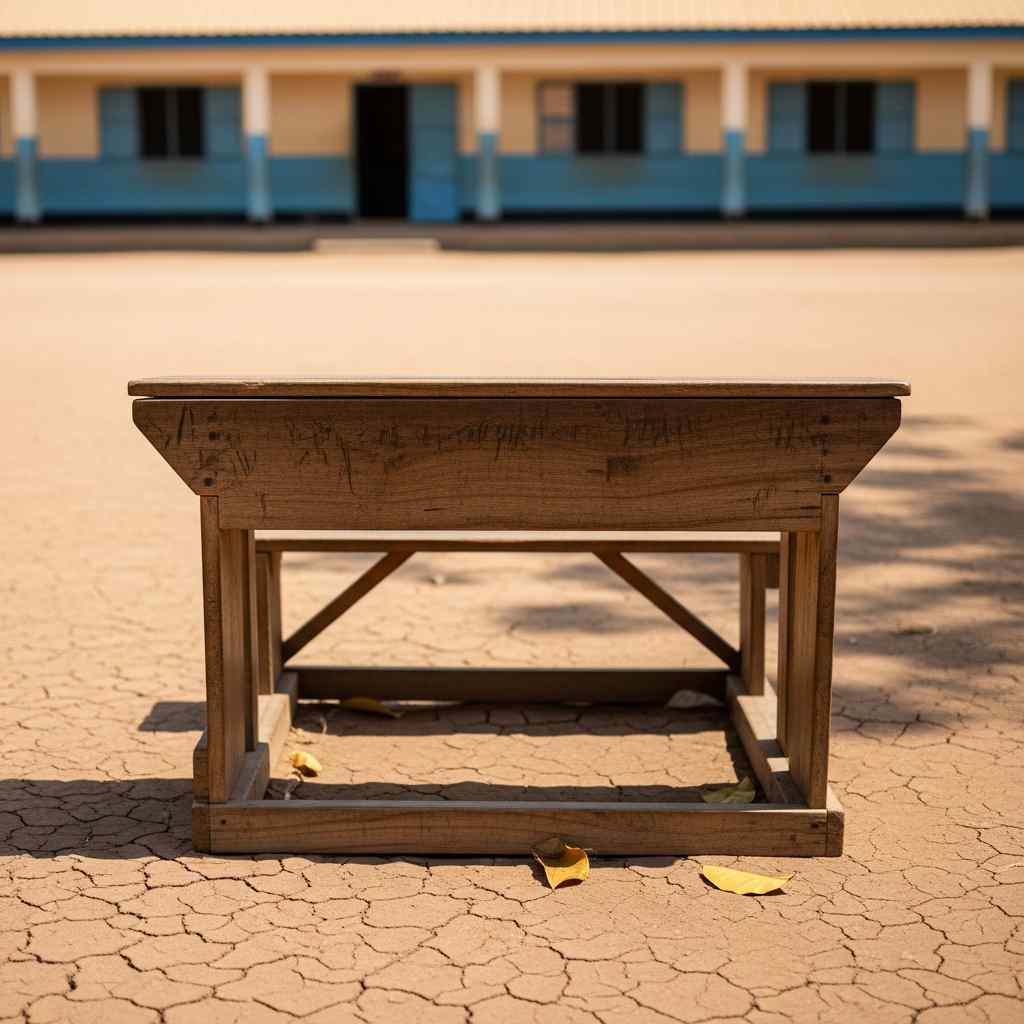
A tool for clearing the board, worn down in a room that has been empty for too long.
Barriers Beyond the Budget That Keep Children at Home
Insecurity across northern regions has forced schools to close permanently, as bandit attacks and kidnappings increasingly target educational institutions. The UNICEF Nigeria representative, Cristian Munduate, stated in January 2026 that conflict had shuttered 11,000 schools, leaving children in these regions with no physical classroom to attend regardless of how much funding sits in government accounts.
Poverty forces families to prioritize immediate income over long-term schooling, and in households with limited resources, children must often work. The National Bureau of Statistics reported a multidimensional poverty rate affecting 63% of the population in 2025, and education funding alone does not address this economic calculus that keeps children out of school.
Cultural norms in certain areas deprioritize formal education, especially for girls, and early marriage remains a persistent challenge. A 2025 report by the World Bank noted significant regional disparities in female enrollment, showing that money allocated to education cannot overcome deeply entrenched social practices without accompanying community engagement.
The Quality Deficit in Schools That Receive Funding
For children who do manage to attend school, the quality of instruction they receive is often poor, and the World Bank report on Learning Poverty in Nigeria published in 2025 found 70% of 10-year-olds cannot read a simple text. Allocated funds rarely translate into effective teacher training or adequate learning materials, meaning children sit in classrooms without acquiring basic literacy.
The pupil-to-qualified-teacher ratio in public primary schools remains alarmingly high, with data from the Federal Ministry of Education for the 2024/2025 academic year showing a national average of 1 teacher for every 55 pupils. In some states, the ratio exceeds 1:100, making meaningful instruction nearly impossible.
School infrastructure across the country suffers from severe neglect, and a 2025 survey by the Civil Society Action Coalition on Education for All found 40% of public primary schools lack functional toilet facilities. Many classrooms have no roofs, and furniture is absent in countless schools where children sit on bare floors.
“We approved funds for classroom construction in 2024. The contractor was paid, but the building has three walls. The children learn under a tree where the fourth wall should be.” – Local Government Education Secretary, Northwest Nigeria, February 2026 interview.
The Fiscal Architecture and the Problem of Leakage
The education funding system involves multiple layers of government, with funds flowing from the federal account to states and then to local government education authorities before reaching schools. Each transfer point presents an opportunity for diversion or delay, and transparency initiatives like the Open Treasury Portal reveal instances of duplicated payments and questionable expenditures.
Audit reports from the Office of the Auditor-General for the Federation consistently cite the education sector for financial irregularities, with the 2024 report highlighting N85 billion in unsubstantiated expenditures across federal educational agencies. Accountability mechanisms remain weak, and those responsible for mismanagement rarely face consequences.
Civil society organizations actively track budget performance, and the CEO of Connected Development, Hamzat Lawal, noted in a January 2026 briefing that community monitoring often uncovers ghost projects. Physical verification of funded school projects regularly shows a mismatch with official records, revealing that money allocated for construction disappears without a single block laid.
Policy Contradictions and the Gaps in Implementation
The government of Nigeria established the National Commission for Almajiri and Out of School Children Education through an Act of Parliament in May 2023, creating a dedicated body to integrate Qur’anic education with basic literacy. The commission began implementing pilot learning centres in late 2025 under the newly announced National Policy on Almajiri Education, yet funding for widespread rollout remains inadequate according to budget documents reviewed in early 2026.
The Alternate School Program, another federal initiative created specifically for out-of-school children, lacks a clear funding line in the 2026 appropriation bill, demonstrating how policy announcements routinely outpace budgetary commitment. This gap between rhetoric and resource allocation has become a recurring theme, leaving families disillusioned with government promises.
State governments carry the primary constitutional responsibility for basic education, yet fiscal constraints at the state level severely hinder their capacity to deliver. Many states allocate over 50% of their budgets to personnel costs according to BudgIT analysis from 2025, leaving little room for capital development in education.
International Benchmarks and the Domestic Reality
The Sustainable Development Goal 4 targets inclusive and equitable quality education for all children by 2030, and Nigeria is significantly off track to meet this goal according to current projections. The Global Education Monitoring Report 2025 placed Nigeria among countries with the highest out-of-school populations, according to UNESCO data, showing how far the nation has fallen behind international benchmarks.
Donor support and international aid supplement government education funding through organizations like UNICEF and the Global Partnership for Education providing grants for specific programs. These funds are project-based and time-bound, however, and they cannot substitute for sustained domestic investment that reaches every child regardless of location.
The economic argument for education investment is compelling, as the World Bank estimates each additional year of schooling raises individual earnings by 10% over a lifetime. The collective cost of inaction for the economy of Nigeria is immense, with millions of children growing into adults without the skills needed to participate in modern society.
The Solution of Transparent Project Tracking
A single, actionable solution exists within current technology and policy frameworks, and the government of Nigeria must mandate and enforce real-time public tracking for every UBEC-funded project across the country. The Federal Ministry of Education and UBEC possess the authority to implement this requirement immediately without waiting for new legislation or additional funding.
The requirement would be simple to execute: every contractor receiving funds for school construction, renovation, or provision of materials must post weekly geo-tagged photos and updates to a public portal linked to the Open Treasury Portal of the government. Community monitors, parent-teacher associations, and civil society organizations would then have immediate access to project status, creating accountability at the point of delivery.
This transparency moves the discussion from budget allocation to tangible output, ensuring that education funding actually builds a classroom wall that stands rather than disappearing into accounts. The technology for this exists and has been proven effective in other sectors through Open Contracting Data Standards implementation elsewhere in government procurement, yet the political will to enforce it remains the variable that determines whether children will finally have schools to attend.
The funding gap between allocation and outcome can be bridged through this single intervention, connecting the flow of money directly to the reality on the ground where children wait. Millions of children sit outside classrooms today, and only implementation that matches intention will bring them inside.






Drone Warfare: The New Threat to Nigerian Border Security

Education Funding Fails Millions of Nigerian Children Out of School

Federal Allocations Rise, Yet 10 States Plan N4.28 Trillion Borrowing Spree

Displaced Persons: Security Agencies Guard Aid Distribution in Nigeria

Rescue Boats Arrive in Yobe After River Tragedy Kills 30

Multiple Taxation and Decay Strangle Lagos Trade Fair

Water Safety: NEDC Warns Against Night Sailing in Northeast Nigeria

Recurrent Spending: Kaduna LGAs Allocate N91 Billion in 2026 Budget

LGA Allocations Rise as Rural Communities Wait for Development

Infrastructure Development: Okrika LGA Presents N11.9 Billion Budget

Landing Jetty Opens in Okrika with Passenger Hall, 2026

The Night Bandits Came: How One Nigerian Community Fought Back

Internet Sovereignty: Why Some Countries Want Their Own Separate Internet

How One Misplaced Dot Broke a Bank Login Page

The Untold Story Of The Nigerian Who Helped Build Global Internet Systems

Nigerian Hackers: The Global Fraud Story and Its Fallout

Forgotten Satellites Defy Silence, Beaming Signals for Decades

Do Not Allow Your Digital Store to Shut Down: The Exact Dates That Kill Websites

The “Village People” Aren’t Blocking Your Sales; Your Bad SEO Is.

The Business That Died: A Nigerian Case Study in Refusal to Adapt

Why Are You Hiding Your Business From People With Money?

How Digital Maps Help Police Find Crime Spots

How Nollywood Grew Without Government Support

Why Criminal Gangs Target Base Transceiver Stations
 Edutech Portal1 month ago
Internet Sovereignty: Why Some Countries Want Their Own Separate Internet
- Digital Hustle1 month ago
How One Misplaced Dot Broke a Bank Login Page
- Edutech Portal1 month ago
The Untold Story Of The Nigerian Who Helped Build Global Internet Systems
- Edutech Portal1 month ago
Nigerian Hackers: The Global Fraud Story and Its Fallout
- Edutech Portal1 month ago
Forgotten Satellites Defy Silence, Beaming Signals for Decades
- Edutech Portal1 month ago
Do Not Allow Your Digital Store to Shut Down: The Exact Dates That Kill Websites
- Edutech Portal1 month ago
The “Village People” Aren’t Blocking Your Sales; Your Bad SEO Is.
- Edutech Portal1 month ago
The Business That Died: A Nigerian Case Study in Refusal to Adapt