Security Technology
Inter-Agency Fusion and the Fight for Nigeria’s Security Data
Here is the thing. Inter-Agency Fusion connects Army, Police, Intelligence. A new platform for data. Sounds good. But trust is low. Infrastructure is weak. So here we are. Can this system work?

Inter-Agency Fusion and the Fight for the Security Data of Nigeria
Published: 17 March, 2026
Can a police report from Maiduguri, army signals intelligence, and a flagged bank transaction ever meet on the same screen? For the officer on the ground in Katsina, that question is a matter of life and death. The inter-agency fusion of security data in Nigeria carries the weight of that imperative, burdened by a long history of institutional failure.
In simple terms, inter-agency fusion is a process. Multiple security agencies combine intelligence reports, operational data, and forensic findings onto one digital platform. The goal is a complete picture. A police report about a suspicious vehicle purchase, combined with army signals on militant communications, combined with financial intelligence on unusual transactions, creates a target for action. This concept moved from theory to a funded project before 2025.
The federal government launched the National Counter-Terrorism Centre (NCTC) Fusion Cell. Its mandate is to oversee data integration between the Nigeria Police Force, the Defence Intelligence Agency (DIA), the Department of State Services (DSS), and the Office of the National Security Adviser (ONSA). A budget allocation of N85 billion was approved for national security coordination in the 2025 fiscal year, with a portion dedicated to this digital integration work (Appropriation Act, 2025). The platform operates on software from a consortium of local and international tech firms.

Why this matters for the officer on the ground
For a police divisional head in Katsina or an army battalion commander in Niger State, the absence of inter-agency fusion has direct consequences. Operations proceed with partial information. The police might raid a compound based on a tip, unaware the army has the same location under surveillance for a different cell leader. Resources duplicate. Opportunities for ambush increase.
The former Chief of Defence Staff, General Christopher Musa, often highlighted this gap. He stated before 2023 that 70% of operational setbacks trace back to intelligence failures rooted in poor inter-service collaboration (Premium Times, 2024).
The new fusion cell promises a change. Authorized personnel access a shared dashboard. Real-time alerts about kidnap hotspots, IED trends, and financier movements populate the screen. The theory suggests a joint patrol in Zamfara receives a consolidated brief minutes before deployment, not a stack of conflicting paper files from four different headquarters. Early reporting from the NCTC in 2025 indicated the platform facilitated the arrest of 15 suspected financiers across three states by cross-referencing financial data with call records and field reports (NCTC Quarterly Bulletin, Q4 2025).
“The greatest weapon against terrorism is not a rifle, it is a byte of timely, accurate information shared with the right unit at the right time.”
Maj. Gen. Adamu Laka, Coordinator, National Counter-Terrorism Centre, speaking at a security conference in Abuja, February 2026.
Here is the thing about trust and turf wars
The technology exists. The larger obstacle is institutional culture. Security agencies guard their information sources with jealousy. A detective views his informant network as personal career capital. A signals intelligence officer protects his methods. Sharing data on a common platform feels like giving away leverage.
This mentality turns digital platforms into empty shells. Agencies upload outdated or sanitized information, keeping the real intelligence within their own closed networks. A 2025 study by the Centre for Democracy and Development (CDD) surveyed mid-level officers across four agencies. 58% of respondents expressed concern that shared intelligence would be credited to another agency, hurting their own promotion prospects. 42% cited a lack of formal protocols to protect sensitive sources once data enters a shared system (CDD Security Sector Report, 2025). The fusion cell requires a legal framework that guarantees data ownership and usage rights. The absence of such a law breeds hesitation.
So what is really happening?
But there is a catch. Advanced platforms assume constant, high-bandwidth internet connectivity. The reality across many operational theaters involves poor network coverage and frequent power outages. A forward operating base in Southern Kaduna might rely on a single satellite phone. Uploading large forensic files or real-time drone footage to a central cloud server becomes a physical impossibility. The digital divide between headquarters in Abuja and units in the field remains wide.
The federal government acknowledges this gap. The 2026 budget includes a line item of N25 billion for the deployment of 500 portable, solar-powered communications hubs to security forces in remote areas (Budget Office of the Federation, 2026). These hubs provide secure, localized network access. They allow field units to query the central fusion database and upload reports without traveling to a state capital. This infrastructure rollout determines whether the fusion cell serves the entire force or remains a tool for desk officers in Abuja.
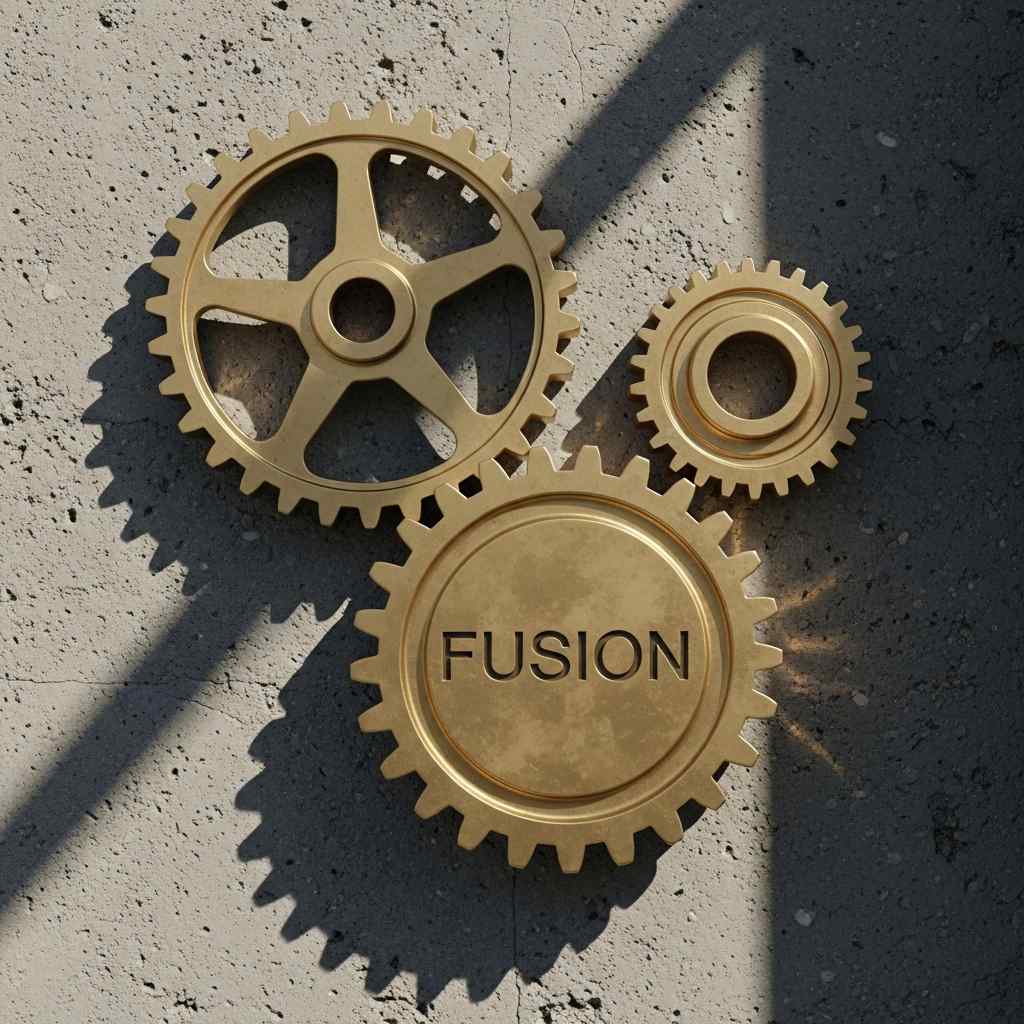
 A new inter-agency data-sharing framework, represented by interlocking gears, aims to synchronize operations between the military, the police, and the intelligence services of Nigeria. The initiative seeks to break down institutional silos and improve national security coordination. (Digital Illustration: GoBeyondLocal)
Where the money goes and who watches it
The budget is substantial. The N85 billion allocation in 2025 represented about 1.7% of the total national budget of N21.8 trillion (Appropriation Act, 2025). This funding covers software licensing, hardware procurement, specialist training, and secure data centers. Civil society organizations like the Civil Society Legislative Advocacy Centre (CISLAC) raise questions about procurement transparency and vendor selection for such sensitive technology.
Oversight is diffuse. The National Assembly committees on Army, Police, National Security, and Intelligence all claim some jurisdiction. No single committee possesses the technical expertise to audit the performance of a complex inter-agency fusion platform. The result is financial reporting that focuses on equipment purchased, not on measurable outcomes like reduced response times or increased interdiction rates. Public accountability for this large expenditure remains weak.
“A platform is only as good as the people who use it. We are training commanders to think jointly, to trust the system, and to act on intelligence that they did not generate themselves. This is a cultural shift.”
A senior trainer at the National Defence College, Abuja, in an interview with The Guardian, January 2026.
A simple way forward
This brings us to a practical path. Instead of aiming for full, real-time integration across all agencies immediately, the fusion cell should start with one specific, high-value target stream. Focus exclusively on integrating all financial intelligence related to terrorism financing from the Nigerian Financial Intelligence Unit (NFIU), the DSS, and the police Special Fraud Unit. Create a single, actionable dashboard for following the money.
This narrow focus builds trust with a success metric, the number of frozen accounts or arrested financiers. It demonstrates tangible value. It allows for the refinement of technical and legal protocols on a manageable scale. A successful pilot on financing becomes the template for expanding to other areas like arms trafficking or kidnap-for-ransom networks. This acknowledges the complexity while delivering a concrete win.
The work of connecting the army, the police, and the spies on a single screen continues. The technology is available. The funding is allocated. The real test lies in overcoming decades of institutional silos and building the trust required for a police officer in Port Harcourt to act on intelligence from an army captain in Sokoto. The security of millions depends on that connection.
The single biggest reason why start-ups succeed | Bill Gross | TED , TED. (Digital Illustration: GoBeyondLocal)











River Disappears Overnight in Warri Delta State

Market Woman Predicts Deaths in Owerri Through Yam Shapes

Forest healer cures blindness using leaves from a plant found nowhere else

Ancient Wall Repairs Itself in Zaria After Heavy Rains

Confluence refuses to mix after a photographer insulted the local river spirit

Church roof collapses mid sermon and every person inside walked out without injury

Tailor Sews Identical Dress from 40-Year-Old Bible Photo in Asaba

Twins Share Single Heartbeat Born Years Apart

Tomi Adeyemi Film Deal Changes Nigerian Storytelling

Lola Shoneyin Builds a Literary Continent at Aké Festival

ADC Leads #OccupyINEC Protest in Abuja Over Party Derecognition

Opay vs Palmpay for International Payments in Nigeria 2026

Internet Sovereignty: Why Some Countries Want Their Own Separate Internet

The Story Of The Nigerian Who Helped Build Global Internet Systems

Nigerian Hackers: The Global Fraud Story and Its Fallout

Forgotten Satellites Defy Silence, Beaming Signals for Decades

Your Digital Store in Nigeria and the Reality of Domain Expiration

The Phone Stay So Quiet: An Investigation into Nigeria’s Silent Customer Lines

The Business That Died: A Nigerian Case Study in Refusal to Adapt

Hiding Your Business From People With Money

How Nollywood Grew Without Government Support

Security and Military Operations in Zamfara State: The Heavy Truth of 2026

Nigeria Produces 67 Percent Global Yam Output

Comedy Industry in Nigeria and Its Economic Contribution


 Digital Sovereignty2 months ago
Internet Sovereignty: Why Some Countries Want Their Own Separate Internet
- Diaspora2 months ago
The Story Of The Nigerian Who Helped Build Global Internet Systems
- Crime2 months ago
Nigerian Hackers: The Global Fraud Story and Its Fallout
- Space Technology2 months ago
Forgotten Satellites Defy Silence, Beaming Signals for Decades
- E-Commerce2 months ago
Your Digital Store in Nigeria and the Reality of Domain Expiration
- Edutech Portal2 months ago
The Phone Stay So Quiet: An Investigation into Nigeria’s Silent Customer Lines
- Edutech Portal2 months ago
The Business That Died: A Nigerian Case Study in Refusal to Adapt
- Business2 months ago
Hiding Your Business From People With Money