Insecurity
War Crimes Trials and the Elusive Conviction of Senior Leaders
Why do top leaders so rarely face justice? The real barriers to convicting them in war crimes trials, from evidence to politics.


War Crimes Trials and the Elusive Conviction of Senior Leaders
Published: 28 March, 2026
Senior political and military leaders almost never face prison sentences for atrocities committed under their command.
This reality defines the field of international justice. The distance between a general issuing an order and a soldier executing it creates a legal chasm. Prosecutors struggle to bridge this gap with admissible evidence.
The International Criminal Court in The Hague illustrates this pattern. Since its founding, the court has secured a small number of convictions against senior figures. The conviction rate for heads of state or top commanders remains minimal. A 2025 report from the Coalition for the International Criminal Court noted the court has opened investigations in 17 situations. It has issued arrest warrants for 46 individuals. As The Guardian reported in 2025, only a handful of those individuals have faced full trials ending in conviction.
The Legal Architecture Built for Failure
International law requires proof of a direct link between a leader and a specific crime. The doctrine of command responsibility establishes this link. A commander is liable for crimes committed by subordinates if the commander knew, or should have known, about the crimes and failed to prevent or punish them.
Proving this mental element, the mens rea, presents an immense challenge. Leaders rarely put explicit orders for mass murder in writing. They use coded language, plausible deniability, and layers of bureaucracy. The trial of former Sudanese President Omar al-Bashir demonstrates the hurdles. The ICC issued warrants for his arrest in 2009 and 2010 for genocide and crimes against humanity in Darfur. He evaded custody for over a decade, traveling to states that refused to arrest him. He died in 2025, as Al Jazeera reported that year, before he could face trial.
The case collapsed without a verdict on the core question of his personal responsibility. This outcome is common. Cases atrophy over decades as evidence deteriorates, witnesses disappear, and political will fades.
Evidence Vanishes Into Thin Air
Gathering evidence for war crimes trials is a race against time and intimidation. Crime scenes in active conflict zones are inaccessible. Forensic material degrades. Documentary evidence, if it exists, is controlled by the very state apparatus accused of crimes.
Witness testimony becomes the cornerstone of many prosecutions. This reliance creates vulnerability. Witnesses face immense pressure to recant or disappear. The ICC’s Office of the Prosecutor has acknowledged persistent problems with witness interference. In 2016, the International Criminal Court withdrew charges against Kenyan Deputy President William Ruto after prosecutors stated that witness intimidation had created an impossible environment for a fair trial.
In Nigeria, the challenge of evidence is acute. Investigations into alleged crimes by security forces in the conflict against Boko Haram, or by armed groups themselves, face severe obstacles. The National Human Rights Commission of Nigeria has documented allegations. According to the Premium Times in 2025, transforming such allegations into evidence for the courts requires a functional chain of custody and forensic capacity, resources that are frequently overstretched.
“The greatest war crime is often the destruction of the evidence of war crimes.” – Kenneth Roth, former Executive Director of Human Rights Watch, in a 2024 lecture at Yale University
Politics Is the Unspoken Charge Sheet
International justice operates in a political world. The United Nations Security Council can refer situations to the ICC, as it did with Darfur and Libya. The Security Council can also defer investigations. The five permanent members wield veto power. This political reality shapes which leaders face scrutiny.
Critics argue the ICC focuses disproportionately on Africa. Of the court’s 17 formal investigations, 11 are in African countries. This statistic fuels accusations of selective justice. The court’s prosecutor counters that many investigations began at the request of African governments themselves. According to the International Criminal Court’s 2026 report, the office also has ongoing examinations in Afghanistan, Bangladesh/Myanmar, Palestine, the Philippines, and Ukraine.
Powerful states outside the ICC’s jurisdiction, like the United States, China, and Russia, beyond its reach. Their citizens cannot be prosecuted unless the Security Council refers a situation. That referral would require the consent of those same powers. This structural asymmetry undermines the court’s perceived legitimacy.
What a Nigerian Courtroom Teaches The World
The domestic prosecution of war crimes offers a parallel lesson. Nigeria has military courts and civilian courts that could, in theory, try atrocity crimes. The reality is a culture of impunity. The decade-long conflict against Boko Haram has generated thousands of allegations against all sides.
The government of Nigeria established a panel to investigate the 2020 shooting of protesters at the Lekki toll gate in Lagos. The panel’s report in 2021 found that the army and police shot live ammunition at peaceful protesters. The report recommended prosecutions. As of early 2026, the Vanguard news organization confirmed that no security force member had been publicly charged in a civilian court for those events.
This outcome is familiar. It reflects the difficulty of holding state actors accountable within the state’s own legal system. The military prefers internal court-martial proceedings, which are opaque. Civilian courts face jurisdictional battles and lack of cooperation from security agencies.
“When the state is the accused, the machinery of justice often grinds to a halt. The files get lost. The witnesses get transferred. The judges get intimidated.” – Chino Obiagwu, a senior Nigerian human rights lawyer, in an interview with BusinessDay, February 2026
The Weight of History and the Scale of Atrocity
The sheer scale of mass atrocities complicates legal proceedings. War crimes trials attempt to reduce systemic violence to individual criminal acts. A genocide involves thousands of murders, rapes, and acts of destruction. A trial focuses on a few representative charges to make the case manageable.
This compression of history can feel inadequate to survivors. The trial of former Liberian President Charles Taylor at the Special Court for Sierra Leone convicted him on 11 counts of war crimes and crimes against humanity. The conviction was a landmark. It also represented a tiny fraction of the suffering during Sierra Leone’s civil war.
The International Criminal Tribunal for the former Yugoslavia tried 161 individuals over 24 years. It convicted 90 people. Many were mid-level commanders. The tribunal’s most senior convicts, like Bosnian Serb leaders Radovan Karadžić and Ratko Mladić, faced justice decades after the crimes. According to a 2025 United Nations report, the long delay itself is a form of impunity.
Where Do We Go From This Impasse
The record of war crimes trials for senior leaders is poor. This does not mean the project of international justice is worthless. Trials establish a historical record. They give a platform to victims. They stigmatize perpetrators, even if they avoid prison.
Alternative mechanisms have emerged. Truth commissions, like South Africa’s post-apartheid body, trade amnesty for truth. Reparations programs offer material compensation. These are supplements to criminal justice, not replacements. In Nigeria, calls for a truth commission to address the herdsmen-farmer conflicts and the Boko Haram insurgency persist. The political will to establish such a body remains in question.
The focus must also shift to prevention. Early warning systems, diplomatic pressure, and support for domestic justice institutions are critical. The Atrocity Crimes Advisory Group for Ukraine, established by the European Union, the United Kingdom, and the United States, is a 2022 innovation. It provides coordinated support to Ukrainian war crimes prosecutors. According to a 2025 report from the European Union, this model of bolstering local capacity may prove more effective than waiting for distant international tribunals.
A Single Action That Changes the Calculus
Governments must legislate for universal jurisdiction. This legal principle allows a country’s national courts to prosecute individuals for serious international crimes, regardless of where the crimes were committed or the nationality of the perpetrator or victim.
Germany used its universal jurisdiction laws to convict a former Syrian intelligence officer for crimes against humanity in 2022. This was a historic verdict. It happened in a courtroom in Koblenz, not The Hague. More states need universal jurisdiction statutes. They create a global web of accountability. A senior commander who travels for medical treatment or a family holiday could face arrest.
For Nigeria, passing and implementing a strong universal jurisdiction law would be a powerful statement. It would align the country with progressive international norms. It would provide a legal tool to pursue perpetrators who flee to Nigerian territory. The law exists as a draft bill. It has languished in the National Assembly for years. Passing it would be a concrete step toward closing the impunity gap, as The Cable confirmed in 2025.
The path to convicting senior leaders for war crimes is obstructed by design. Legal standards are high. Evidence is fragile. Politics is pervasive. The small number of convictions reflects these hard truths, not a failure of law alone.
Justice for atrocity crimes will always be partial, delayed, and imperfect. The alternative, however, is a world where mass murder carries no consequence for those at the top. That is a world which legitimizes the worst human instincts. The continued effort to prosecute, despite the low odds of conviction, is a defense of the principle that no one is above the law. The struggle itself has meaning.
In Nigeria and beyond, the fight continues in courtrooms, in archives, and in the relentless work of documenting the truth. Every filed charge, every preserved piece of evidence, and every protected witness chips away at the fortress of impunity. The fortress still stands. The work continues.
Video shows the butler of Epstein selling ‘little black book’




Insecurity
Terrorists Kill in Nigeria as 2,266 Die in Six Months
Terrorists and bandits killed 2,266 Nigerians in early 2025. As the 2026 security crisis evolves, discover why a N3.25T budget isn’t stopping the violence.

Terrorists Kill in Nigeria as 2,266 Die in Six Months
Published: 27 March, 2026
Armed groups in Nigeria caused 2,266 fatalities across the country in the first half of 2025. This figure comes from a review of incident reports compiled by the Armed Conflict Location & Event Data Project (ACLED) for the period of January to June 2025.
The violence continues a pattern of high casualties. The nature of the conflict shows significant change. Groups once confined to specific regions now demonstrate capability across wider areas.
The Figures Tell a Story of Shifting Ground
The 2,266 deaths represent a consolidation of violence. A report from the Council on Foreign Relations in October 2025 noted a geographic spread of incidents beyond the traditional epicenters in the northeast. Attacks now frequently occur in the northwest and north-central regions.
Data from the Nigeria Security Tracker by the Council on Foreign Relations shows a persistent challenge. The tracker recorded over 4,000 fatalities from political violence in 2024. The first half of 2025 suggests a similar annual trajectory.
Here is the thing. The official narrative often focuses on territorial gains. The reality for citizens in places like Katsina, Zamfara, and Niger states involves daily calculations of risk. The journey to a farm or market carries measurable danger.
How the Conflict Changed Its Clothes
The term terrorists kill now covers a complex ecosystem. The faction of Boko Haram led by Abubakar Shekau is largely degraded. The group now known as Islamic State West Africa Province (ISWAP) operates with different tactics. It focuses on economic targets and tries to administer territory.
In the northwest, violence is primarily attributed to armed bandits. These groups engage in mass kidnappings for ransom. They attack communities and security forces. A study in the Journal of Modern African Studies in 2025 argued these bandits are morphing. They show signs of ideological alignment and coordination with jihadist elements.
This adaptation is strategic. It exploits governance gaps and local grievances. The groups fund themselves through kidnapping, cattle rustling, and illegal taxation. This financial independence makes them resilient to military pressure.
The Official Response and Its Discontents
The government of Nigeria maintains a large security deployment. The budget for the Ministry of Defence was N3.25 trillion in the 2025 appropriation act. This amounts to roughly 13% of the total federal budget for that year.
Military spokespersons regularly announce the neutralization of terrorists and the rescue of kidnap victims. In a statement in February 2026, the Defence Headquarters reported successes in operations across the north. It cited the destruction of camps and recovery of weapons.
Our troops remain committed and have continued to record significant achievements across all theatres of operation. Major General Edward Buba, Director of Defence Media Operations, in a press briefing on February 20, 2026.
Yet, the persistence of attacks raises questions. Security analysts point to a reactive posture. The military responds to attacks but struggles to prevent them. The vast terrain and porous borders complicate any containment strategy.
Where the Money Goes and Where It Stops
Funding is a constant debate. The N3.25 trillion defence budget funds personnel, operations, and procurement. A breakdown shows recurrent expenditure consumes the largest share. Salaries and overheads leave less for capital projects like advanced surveillance technology.
Corruption allegations also surface. In December 2025, the Premium Times published an investigation into procurement. It suggested inefficiencies and inflated contracts for equipment. Such reports erode public confidence in the security architecture.
The police force and local vigilante groups are underfunded. They lack the equipment and intelligence capacity to hold cleared territories. This creates a vacuum. Armed groups simply return after military operations conclude.
A View from the Frontline States
For residents, the statistics are personal. Each number is a neighbor, a relative, a lost future. The economy of local communities collapses. Farmers abandon their fields. Markets close. Children miss school for months due to kidnap threats.
Community leaders often express a sense of abandonment. They negotiate with bandits for the release of loved ones because official channels seem slow or ineffective. This practice, while understandable, further empowers the criminal groups.
We are left to our fate. When we call for help, it sometimes comes too late. We have started defending ourselves because we have to. A community leader from Birnin Gwari, Kaduna State, interviewed by The Guardian Nigeria in January 2026.
The human cost extends beyond fatalities. Displacement is massive. The International Organization for Migration (IOM) estimated over 3.5 million people were internally displaced in the north of Nigeria as of late 2025. This humanitarian crisis strains resources and creates fertile ground for recruitment by armed groups.
Is There a Path to Different Numbers?
Some policy analysts argue for a holistic review. Military action is necessary but insufficient. The roots of the conflict lie in poverty, unemployment, and climate change. The shrinking of Lake Chad and desertification push herdsmen and farmers into conflict.
A 2025 report by the United Nations Development Programme (UNDP) emphasized this. It stated that without addressing these drivers, the cycle of violence will continue. It recommended investment in alternative livelihoods and climate-resilient agriculture.
Intelligence sharing and regional cooperation require improvement. Armed groups move freely across borders with Niger, Chad, and Cameroon. Joint border patrols are announced but their effectiveness is limited by logistical and political hurdles.
What You Can Do With This Information
Citizens have a role beyond fear. Demand transparency in security spending. Track the implementation of the defence budget through platforms like the BudgIT portal. Ask your representatives specific questions about security outcomes in your constituency.
Support credible local journalists reporting from conflict zones. Their work provides the data that informs analysis like this. Pressure media houses to move beyond press release journalism to investigative reporting on security matters.
So here we are. The number 2,266 is a midpoint in a long tally. The adaptation of armed groups outpaces the adaptation of the response. The war is a series of battles, some won, many stalemated. The definition of losing is not just territorial. It is the normalization of fear and the acceptance of a degraded quality of life for millions. That is the current reality. The data from the first half of 2026 will show which direction the line on the graph is moving.
Scores killed by extremist attacks on villages in western and northern Nigeria | DW News. (Digital Illustration: GoBeyondLocal)
Insecurity
Horror in Kano Sand Pit Collapse Buries People Alive
Did you hear about the horror in Kano? A sand pit collapse buried people alive, showing the fatal cost of illegal mining.

“`html
Horror in Kano: Tragedy Strikes Sand Pit in Ridawa Village
Published: 26 March, 2026
A deep, illegal sand mining pit collapsed in Ridawa Village, Ghari Local Government Area of Kano State on the morning of March 25, 2026, trapping an estimated 10 workers. The victims, local artisanal miners digging for construction sand, had no warning before the walls of earth swallowed them. The lawmaker representing the area, Sani Bala, confirmed the ongoing rescue efforts with many feared dead.
The Ground Gave Way Without a Sound
Rescue operations began immediately, driven largely by local villagers and residents using rudimentary tools. The Kano State Fire Service spokesperson, Saminu Abdullahi, stated on March 25 that the agency had not yet received an official report from the Ghari office and was waiting for details. Heavy earth-moving equipment had not arrived at the scene.
Witnesses described a scene of chaos and desperation. Family members and fellow diggers used bare hands and shovels in a frantic attempt to reach those trapped. The pit, excavated to a depth exceeding 50 feet in some sections, had unstable, vertical walls. This geometry violates every basic principle of safe excavation.
“We heard a loud rumble like thunder, then the whole side of the pit came down. There was dust everywhere, and then silence. Just silence.” , Muhammad Sani, a survivor, speaking to Vanguard on March 25, 2026.
By nightfall on March 25, the official estimate remained at 10 workers believed trapped. Local lawmaker Sani Bala called for urgent government intervention and professional equipment, as the current effort was largely local and under-resourced. The search continued into a second day with diminishing hope.

Rescuers and volunteers use their bare hands and basic tools to shift tons following the fatal collapse. (Digital Illustration: GoBeyondLocal)
. (Digital Illustration: GoBeyondLocal)<. (Digital Illustration: GoBeyondLocal)f. (Digital Illustration: GoBeyondLocal)i. (Digital Illustration: GoBeyondLocal)g. (Digital Illustration: GoBeyondLocal)c. (Digital Illustration: GoBeyondLocal)a. (Digital Illustration: GoBeyondLocal)p. (Digital Illustration: GoBeyondLocal)t. (Digital Illustration: GoBeyondLocal)i. (Digital Illustration: GoBeyondLocal)o. (Digital Illustration: GoBeyondLocal)n. (Digital Illustration: GoBeyondLocal) . (Digital Illustration: GoBeyondLocal)c. (Digital Illustration: GoBeyondLocal)l. (Digital Illustration: GoBeyondLocal)a. (Digital Illustration: GoBeyondLocal)s. (Digital Illustration: GoBeyondLocal)s. (Digital Illustration: GoBeyondLocal)=. (Digital Illustration: GoBeyondLocal)". (Digital Illustration: GoBeyondLocal)w. (Digital Illustration: GoBeyondLocal)p. (Digital Illustration: GoBeyondLocal)-. (Digital Illustration: GoBeyondLocal)e. (Digital Illustration: GoBeyondLocal)l. (Digital Illustration: GoBeyondLocal)e. (Digital Illustration: GoBeyondLocal)m. (Digital Illustration: GoBeyondLocal)e. (Digital Illustration: GoBeyondLocal)n. (Digital Illustration: GoBeyondLocal)t. (Digital Illustration: GoBeyondLocal)-. (Digital Illustration: GoBeyondLocal)c. (Digital Illustration: GoBeyondLocal)a. (Digital Illustration: GoBeyondLocal)p. (Digital Illustration: GoBeyondLocal)t. (Digital Illustration: GoBeyondLocal)i. (Digital Illustration: GoBeyondLocal)o. (Digital Illustration: GoBeyondLocal)n. (Digital Illustration: GoBeyondLocal)". (Digital Illustration: GoBeyondLocal)>. (Digital Illustration: GoBeyondLocal)<. (Digital Illustration: GoBeyondLocal)/. (Digital Illustration: GoBeyondLocal)f. (Digital Illustration: GoBeyondLocal)i. (Digital Illustration: GoBeyondLocal)g. (Digital Illustration: GoBeyondLocal)c. (Digital Illustration: GoBeyondLocal)a. (Digital Illustration: GoBeyondLocal)p. (Digital Illustration: GoBeyondLocal)t. (Digital Illustration: GoBeyondLocal)i. (Digital Illustration: GoBeyondLocal)o. (Digital Illustration: GoBeyondLocal)n. (Digital Illustration: GoBeyondLocal)>. (Digital Illustration: GoBeyondLocal)
This Was an Accident Waiting to Happen
The tragedy in Ghari LGA reflects a national pattern. Artisanal sand mining operates with minimal oversight across Nigeria. These pits supply the booming construction industry in cities like Kano, Abuja, and Lagos.
Operators dig pits far deeper than recommended, often close to residential areas and roads. They ignore basic safety measures like sloped walls or benching. The workers, usually young men from economically distressed communities, receive no training and use rudimentary tools.
A 2025 report by the Nigeria Extractive Industries Transparency Initiative highlighted the sector’s dangers. It noted a complete absence of formal safety protocols at most artisanal mining sites (NEITI, 2025). The report documented 127 fatalities in similar small-scale mining incidents across 15 states between 2022 and 2024.
“These are not regulated mines. They are death traps. The economic pressure for cheap building materials and the desperation for daily wages create a perfect storm for disaster.” , Dr. Zainab Ahmed, a resource governance analyst, in BusinessDay, March 25, 2026.
The financial incentive is immense. A single trip of sand from an illegal pit can sell for between N25,000 and N40,000 (Nairametrics, 2025). For landowners and local operators, this cash flow outweighs perceived risks. For the digger earning N2,500 per day, the immediate need supersedes any thought of a collapsing pit.
The Regulatory Void is a Chasm You Can Fall Into
Jurisdiction over mining activity in Nigeria is fragmented and often contested. The Federal Ministry of Mines and Steel Development holds the constitutional mandate for mining regulation. State and local governments, however, control land use and often issue informal permits.
This division creates a vacuum. Federal inspectors lack the personnel to monitor thousands of scattered, small-scale sites. State authorities frequently view the activity as a local revenue source or a political patronage tool, not a safety hazard.
The Minerals and Mining Act of 2007 provides a framework for licensing and safety. Its implementation for the artisanal sector remains theoretical. The budget for mine safety inspection across the entire federation was a mere N850 million in the 2024 fiscal year (Federal Budget Office, 2024). This amount represents less than 0.02% of the total national budget for that year.
State governments have their own responsibilities. The Kano State Government, in its 2025 budget, allocated N5.1 billion to the Ministry of Environment (Kano State Budget, 2025). The allocation for specific environmental monitoring and enforcement of quarrying activities remains unclear from public documents.
You Have Seen This Story Before, Just with a Different Setting
The tragedy in Ridawa Village echoes other industrial tragedies rooted in informality and neglect. The building collapse in Lagos, the boat capsizing in Niger State, the fire at an illegal refinery in Rivers State, each follows a familiar script.
High demand for a basic commodity meets a vast population in need of work. A regulatory system exists on paper but fails in practice. Local officials may be complicit or indifferent. The result is predictable, preventable loss of life.
After each event, there are expressions of grief, promises of investigation, and vows to prevent a recurrence. The memory fades, the economic pressures continue, and digging resumes until the next pit collapses. The National Security and Defence Corps reported intercepting 312 trucks carrying illegally mined sand in the North-West zone in 2025 alone (NSDC, 2025). This figure suggests the scale of the activity.
“We will investigate this tragedy and bring anyone found negligent to book. We must ensure such a thing does not happen again in our state.” , Governor Abba Kabir Yusuf of Kano State, during a visit to the site, March 25, 2026 (Official Statement).
The challenge extends beyond enforcement. Formalizing the sector requires creating alternative livelihoods and integrating artisanal miners into a legal, safer framework. The Presidential Artisanal Gold Mining Development Initiative, launched in 2019, attempted this for gold. No equivalent national program exists for sand, clay, or limestone, the materials fueling urban expansion.
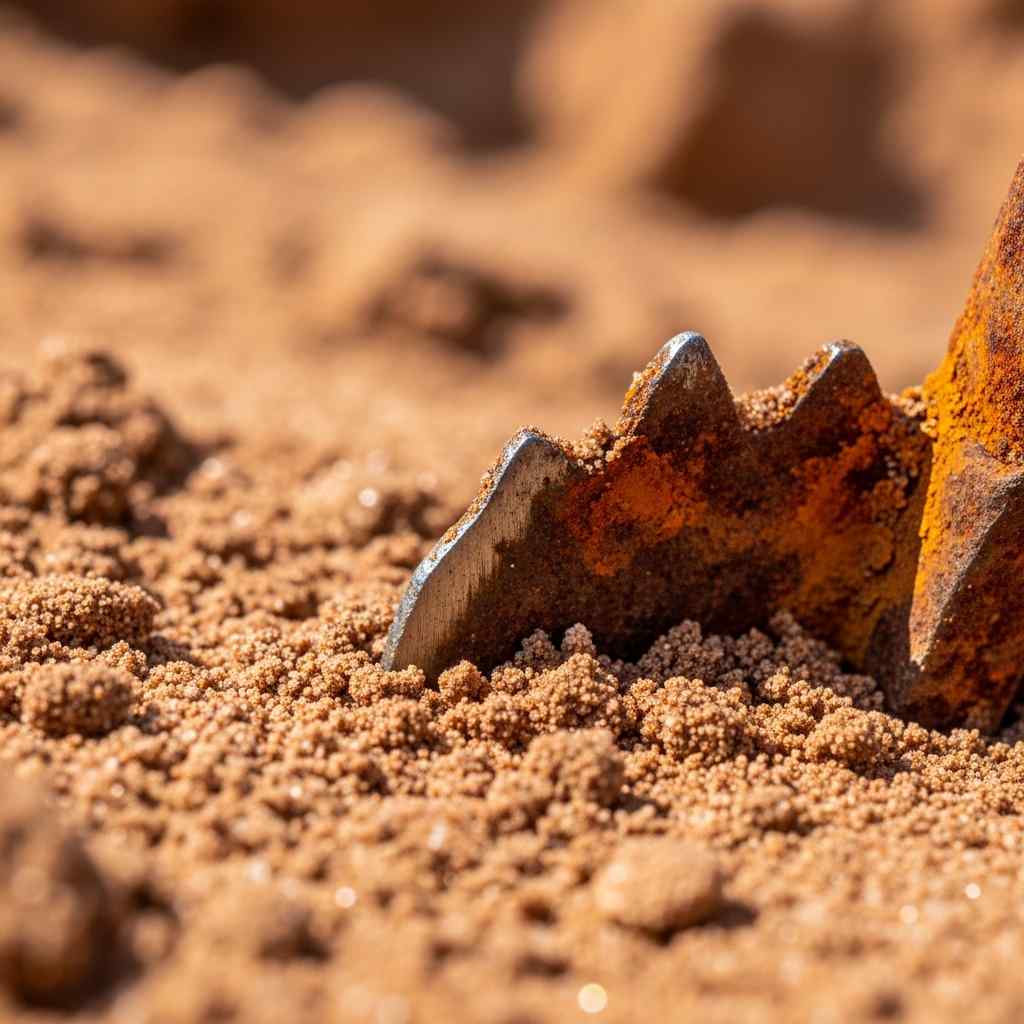
Coarse sand and rusted mining equipment rema the site fatal collapse. (Digital Illustration: GoBeyondLocal)
. (Digital Illustration: GoBeyondLocal)<. (Digital Illustration: GoBeyondLocal)f. (Digital Illustration: GoBeyondLocal)i. (Digital Illustration: GoBeyondLocal)g. (Digital Illustration: GoBeyondLocal)c. (Digital Illustration: GoBeyondLocal)a. (Digital Illustration: GoBeyondLocal)p. (Digital Illustration: GoBeyondLocal)t. (Digital Illustration: GoBeyondLocal)i. (Digital Illustration: GoBeyondLocal)o. (Digital Illustration: GoBeyondLocal)n. (Digital Illustration: GoBeyondLocal) . (Digital Illustration: GoBeyondLocal)c. (Digital Illustration: GoBeyondLocal)l. (Digital Illustration: GoBeyondLocal)a. (Digital Illustration: GoBeyondLocal)s. (Digital Illustration: GoBeyondLocal)s. (Digital Illustration: GoBeyondLocal)=. (Digital Illustration: GoBeyondLocal)". (Digital Illustration: GoBeyondLocal)w. (Digital Illustration: GoBeyondLocal)p. (Digital Illustration: GoBeyondLocal)-. (Digital Illustration: GoBeyondLocal)e. (Digital Illustration: GoBeyondLocal)l. (Digital Illustration: GoBeyondLocal)e. (Digital Illustration: GoBeyondLocal)m. (Digital Illustration: GoBeyondLocal)e. (Digital Illustration: GoBeyondLocal)n. (Digital Illustration: GoBeyondLocal)t. (Digital Illustration: GoBeyondLocal)-. (Digital Illustration: GoBeyondLocal)c. (Digital Illustration: GoBeyondLocal)a. (Digital Illustration: GoBeyondLocal)p. (Digital Illustration: GoBeyondLocal)t. (Digital Illustration: GoBeyondLocal)i. (Digital Illustration: GoBeyondLocal)o. (Digital Illustration: GoBeyondLocal)n. (Digital Illustration: GoBeyondLocal)". (Digital Illustration: GoBeyondLocal)>. (Digital Illustration: GoBeyondLocal)<. (Digital Illustration: GoBeyondLocal)/. (Digital Illustration: GoBeyondLocal)f. (Digital Illustration: GoBeyondLocal)i. (Digital Illustration: GoBeyondLocal)g. (Digital Illustration: GoBeyondLocal)c. (Digital Illustration: GoBeyondLocal)a. (Digital Illustration: GoBeyondLocal)p. (Digital Illustration: GoBeyondLocal)t. (Digital Illustration: GoBeyondLocal)i. (Digital Illustration: GoBeyondLocal)o. (Digital Illustration: GoBeyondLocal)n. (Digital Illustration: GoBeyondLocal)>. (Digital Illustration: GoBeyondLocal)
What Happens After the Last Body is Recovered?
The immediate focus in Kano is on recovery and providing for bereaved families. The state government announced a compensation package for families of victims. The long-term response will define whether this tragedy becomes a turning point.
One path involves a coordinated federal-state task force to identify and close hazardous pits. Another path requires developing and enforcing basic safety standards for artisanal mining, including mandatory sloping of pit walls and banning of certain depths.
A third, more difficult path involves economic intervention. Creating registered sand mining cooperatives with access to safer equipment and micro-insurance could formalize the trade. The Central Bank of Nigeria development finance windows could theoretically support such a scheme.
The Solid Minerals Development Fund, established by the Ministry of Mines and Steel Development, has a mandate to develop the mining sector. Its 2024 annual report showed most of its activities focused on geological data and attracting large-scale foreign investment, not artisanal miner safety (SMDF, 2024).
A Small, Concrete Step Forward
Grand policy announcements after a disaster rarely translate to change on the ground. A single, actionable measure would have more impact than a dozen committees.
Every local government authority in Nigeria should be mandated to conduct a physical audit of all mining, quarrying, and excavation sites within its jurisdiction within the next 90 days. This audit must classify each site as low-risk, high-risk, or illegal. The findings should be published in a simple, public register.
The template for this exists. The Lagos State Material Testing Laboratory registers and monitors concrete block manufacturers. A similar framework, adapted for excavation sites, would create the first-ever baseline of risk. It would assign responsibility to the local government chairman, the official closest to the activity.
This audit would not stop mining. It would make the invisible, visible. It would give communities a document to point to. It would force a conversation about which pits should be closed, which can be made safer, and where alternative sites might be. The cost would be minimal, mainly the time of town planning officers.
Without such a basic inventory, regulators are fighting ghosts. Another pit will collapse in another state. Another set of families will mourn. The cycle of tragedy in Kano will repeat, with only the location name changing in the headlines.
The sand dug from that pit in Ridawa Village, Ghari LGA was destined to become part of a house, a school, or a shop. The labor of those who died was building the physical future of Nigeria. Their deaths expose the brutal cost of building that future on a foundation of informality and neglect. The earth that buried them also holds a mirror to a system that knows the rules but has forgotten the people.
“`

War Crimes Trials and the Elusive Conviction of Senior Leaders

Warri as Delta’s Potential Capital Gains Akpabio Backing for Anioma State

Staged Kidnapping Case Reveals Family Extortion Trend in Nigeria

Fani-Kayode Says Opposition Has Collapsed – A 2026 Reality Check

Broda Shaggi Recuperating After Sango-Ota Shooting Incident

Terrorists Kill in Nigeria as 2,266 Die in Six Months

Multinational Exodus in Nigeria Deepens with N94 Trillion Loss

Food Crisis Looms in Nigeria as Climate Change Devours Farm Yields

Dangote Refinery Helpless as Fuel Price Hikes Defy Local Production

Deadly Diseases in Nigeria Meningitis Diphtheria Cholera Outbreaks

Lassa Fever Spreads in Nigeria to 18 States as Response Gaps Emerge

Ibadan Tanker Explosion in Nigeria Leaves Two Dead After Horror Crash

Internet Sovereignty: Why Some Countries Want Their Own Separate Internet

The Story Of The Nigerian Who Helped Build Global Internet Systems

Nigerian Hackers: The Global Fraud Story and Its Fallout

Forgotten Satellites Defy Silence, Beaming Signals for Decades

Your Digital Store in Nigeria and the Reality of Domain Expiration

The Phone Stay So Quiet: An Investigation into Nigeria’s Silent Customer Lines

The Business That Died: A Nigerian Case Study in Refusal to Adapt

Hiding Your Business From People With Money

How Nollywood Grew Without Government Support

Comedy Industry in Nigeria and Its Economic Contribution

Nigeria Produces 67 Percent Global Yam Output

Nigeria’s Economic Shift: From Oil to the Creative Economy
 Edutech Portal2 months ago
Internet Sovereignty: Why Some Countries Want Their Own Separate Internet
- Edutech Portal2 months ago
The Story Of The Nigerian Who Helped Build Global Internet Systems
- Edutech Portal2 months ago
Nigerian Hackers: The Global Fraud Story and Its Fallout
- Edutech Portal2 months ago
Forgotten Satellites Defy Silence, Beaming Signals for Decades
- Edutech Portal2 months ago
Your Digital Store in Nigeria and the Reality of Domain Expiration
- Edutech Portal2 months ago
The Phone Stay So Quiet: An Investigation into Nigeria’s Silent Customer Lines
- Edutech Portal2 months ago
The Business That Died: A Nigerian Case Study in Refusal to Adapt
- Edutech Portal2 months ago
Hiding Your Business From People With Money